


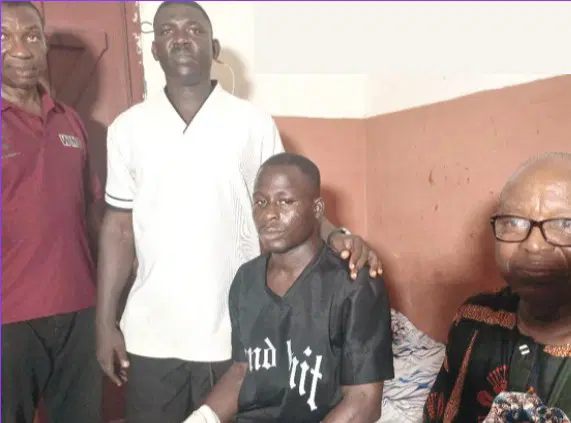
UMUAHIA: In an unprecedented display of community mobilization against rural insecurity, local youths from the Ohuhu community in Umuahia North Local Government Area of Abia State successfully ventured into a dense forest to rescue two abducted residents following a four-hour confrontation with armed bandits.
The successful rescue stands in stark contrast to the broader security crisis across Nigeria, where thousands of citizens remain in captivity. Recent incidents highlight the scale of the issue, including the ongoing captivity of thirty-nine students and toddlers alongside seven teachers abducted from two schools in Oyo State, as well as a separate group of students seized in Borno State. Across regions such as Katsina, Zamfara, Niger, Kogi, Benue, Plateau, and Kwara, rural communities face continuous threats from criminal syndicates demanding exorbitant ransoms, which frequently results in the death of hostages.
The Ambush and Captivity
The incident in Abia State began on a Wednesday morning as Onyinyechi Jonathan Ekechukwu, a widowed peasant farmer and mother of four, was returning from her farm after harvesting cassava. To transport her produce, she engaged the services of Dennis Okechi, a local commercial tricycle operator.
During their journey back to the village, armed men identified as Fulani bandits ambushed the vehicle, forcing both individuals into the thick forest under the threat of immediate violence. According to accounts from the victims, the six-man gang confiscated their mobile phones and marched them through the terrain for several hours.
During the trek, Okechi attempted to escape, resulting in the bandits stabbing him, blindfolding him, and inflicting further physical assault. By late evening, the captors demanded a ransom of N10 million from the victims' families. When Ekechukwu attempted to communicate with her relatives in her native Igbo language, she was physically assaulted by the guards, who demanded negotiations be conducted in English. The captors eventually halted their movement at a traditional farmers' resting point known as Ikeotuonye before crossing a nearby river.
A Desperate Struggle and Community Mobilization
While in captivity, Okechi believed his execution was imminent when the guards attempted to remove his blindfold. In a bid for survival, he initiated a physical altercation, engaging three of the bandits inside a ditch. Although he managed to disarm one attacker of a weapon, he was ultimately overpowered and suffered severe machete and blunt-force injuries.
Simultaneously, word of the abduction reached the Umuawa Alocha community. The President General of the community, Chimex Uluocha, immediately activated the local security network while contacting formal security agencies, including the Nigerian Army and the Nigeria Police Force. Recognizing that standard operational protocols might delay an immediate response, local youths—some under twenty years of age—volitionary organized a search party equipped with hunting dogs, flashlights, and local tools.
Following tactical advice from a regional homeland security official, the youth strategy focused on creating a loud, multi-directional perimeter disturbance rather than a stealth approach, aiming to confuse the armed abductors and prevent coordinated retaliation against the hostages.
The Forest Confrontation and Rescue
As the youth search party advanced into the vast forest terrain, they utilized localized gunfire and structural noise to disorient the criminal gang. After hours of searching, the rescue team tracked the audio signals of the victims near a riverbank.
Sensing they were being surrounded by an advancing, aggressive crowd, the bandits abandoned the hostages and fled across the river into the darkness. The youths subsequently secured both victims, transporting Okechi to a private medical facility in Umuahia where he remains under treatment for head and hand injuries.
Demands for Security Reforms
The aftermath of the crisis has prompted community leaders to demand substantial shifts in regional security policies. Uluocha emphasized that while formal police leadership visited the village post-incident, the immediate intervention was entirely executed by the community's youth. He argued for a decentralized security architecture that formally recognizes, equips, and incentivizes rural communities as legitimate first responders.
Furthermore, geographical assessments conducted during the rescue indicated that the criminal elements were unfamiliar with the local terrain, as they frequently questioned the victims regarding neighboring village borders, suggesting an infiltration from outside the immediate region. Local farmers have also renewed calls for strict government enforcement against open cattle grazing, noting that persistent crop destruction by armed herders has previously compromised rural stability.
Official Government and Police Responses
The Abia State Police Command, via a public statement issued by the Police Public Relations Officer, Maureen Chinaka, confirmed the operational details. The command noted that operatives from the Ohuhu Divisional Police Headquarters, working in tandem with local vigilantes, forest guards, and youths, entered the bush to secure the victims. The police confirmed that the kidnappers fled upon noticing the advancing joint forces and stated that active investigations are underway to apprehend the fleeing suspects.
Addressing broader regional anxieties regarding demographics and security, the Special Adviser to the Governor on Security Matters, retired Navy Commander MacDonald Ubah, dismissed concerns over the rising population of northern migrants in the state. Ubah characterized the migration as an indicator of Abia’s expanding commercial viability, noting that many migrants work within the transport sector and would likely relocate if specific municipal transit adjustments occur.
The security adviser acknowledged ongoing attempts by syndicates to establish strongholds within the state's forest reserves but asserted that ongoing synergy between state forces and community vigilantes continues to neutralize these networks. The state government reiterated its policy that no territory within Abia State would be conceded to criminal elements, adding that numerous successful counter-bravado operations remain unpublicized to preserve operational security.