


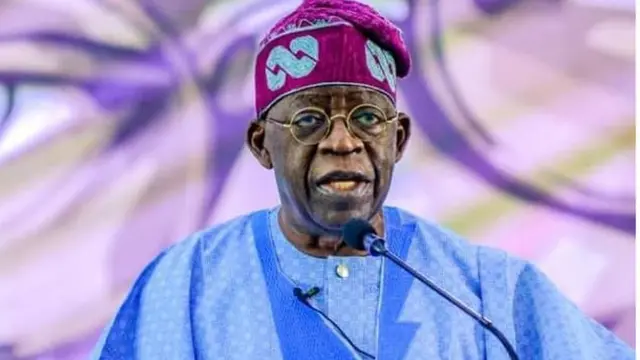
President Bola Tinubu
President Bola Tinubu has once again mounted a vigorous defense of his administration’s landmark economic policies, characterizing the removal of fuel subsidies and the unification of the foreign exchange market as "critical" measures essential for Nigeria's survival.
Speaking during an interview at the Africa CEO Forum in Kigali, the President acknowledged the significant hardship these reforms have caused but likened the current economic climate to the pains of childbirth—a temporary struggle destined to yield long-term joy.
“It is difficult, it is painful, but it is just like the human reproduction process,” Tinubu remarked. “A woman carries a pregnancy, endures the pain of labor, and has a very big smile when she sees a live child.”
Ending the "Wasteful" Subsidy Regime
Addressing the decision to scrap the long-standing fuel subsidy shortly after his inauguration in 2023, the President argued that maintaining the old system would have effectively "spent the future of unborn generations." He dismissed the notion of continued subsidies as living a "fake life" in a global economy, noting that the old regime encouraged smuggling and the falsification of records.
Tinubu highlighted the dire fiscal state of the nation prior to these changes, noting that 27 out of Nigeria's 36 states were unable to meet basic salary obligations. "Where is the money?" he asked. "You are oil-producing... yet you have no refinery that is functional. It is not possible to continue that trend."
Taxation and Civic Responsibility
The President also addressed the necessity of a robust tax system, framing it as the only viable way to fund modern infrastructure and social services. He challenged citizens to reconcile their demands for high-quality highways and hospitals with their reluctance to pay taxes.
"Taxation is not friendly to the wealthy, the middle class, or the poor. But how do you care for the vulnerable? How do you protect the future of the children?"
Economic Outlook and the 2027 Horizon
Looking ahead to a potential second term in 2027, President Tinubu projected that his focus would remain on "more work" and continuing the process of "resetting and rethinking" the nation’s governance. He claimed that the early gains of his reforms are already visible, asserting that the Naira has achieved a level of stability and predictability that allows businesses and households to plan effectively.
Key Social and Industrial Highlights:
Social Safety Nets: The administration is implementing direct cash transfers to vulnerable households and providing upkeep allowances for indigent students via education grants.
Industrial Support: Tinubu emphasized a "Nigeria First" policy, citing the approval of crude oil sales to the Dangote Refinery in Naira to reduce foreign exchange pressure.
Infrastructure: He defended the Lagos-Calabar Coastal Highway as a tool for national integration, noting that the project prioritizes locally produced cement and steel to stimulate domestic industry.
Regional Leadership and Unity
On the diplomatic front, Tinubu dismissed claims that Nigeria’s influence has waned. He described Nigeria as the "big brother" of ECOWAS and the "fat lady" of Africa, asserting that the nation must continue to "sing the right tune" to lead the continent.
Closing on a note of national unity, the President urged Nigerians to embrace their diversity as a source of strength. "Your parents could be Igbo, my parents could be Yoruba... where you find yourself is your home," he said. "This country is ours. We must build it together.