


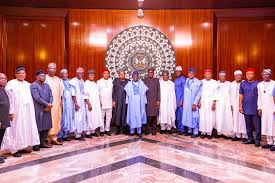
The 36 state governors of Nigeria, operating under the Nigeria Governors’ Forum (NGF), have reaffirmed their support for the immediate creation of state police. During their recent meeting in Abuja, the governors emphasized that the proposed security framework must be constitutionally sound, align with the principles of federalism, and safeguard citizens’ rights.
This collective stance follows significant legislative progress, as the House of Representatives and the Senate recently passed the constitutional amendment bill seeking to establish state police through its second reading.
Key Resolutions from the NGF Meeting
Led by NGF Chairman and Kwara State Governor AbdulRahman AbdulRazaq, the forum deliberated on critical national issues and resolved to deepen coordination between state and federal institutions.
-
Security Integration: The governors reviewed presentations from the NGF Secretariat and state Attorneys-General regarding the readiness requirements for state policing, which include governance structures, financing models, human capital standards, and oversight mechanisms.
-
Power Sector Reforms: The NGF reiterated its commitment to expanding access to affordable and reliable electricity. The governors reviewed the National Solar Super-Grid (NSSG) Initiative, a proposal designed to integrate large-scale, decentralized solar generation with the national high-voltage transmission network to boost industrialization and energy security.
-
National Nutrition 774 Initiative: The forum pledged support for federal efforts to reduce child malnutrition. Governors expressed commitment to the National Nutrition Bill and endorsed the World Bank’s proposed Country Partnership Framework for 2026–2032, which focuses on sustainable agricultural value chains and early childhood development.
Blueprint of the Proposed State Police Framework
The proposed constitutional amendments outline a dual-structure policing system designed to decentralize law enforcement while maintaining national standards.
Structural Division and Operational Boundaries
The amendment establishes two distinct entities: the Federal Police and individual State Police forces created by state legislation. A state cannot operationalize its force until it is certified as meeting the national minimum standards prescribed by the National Assembly. Until a state force becomes operational, the Federal Police will maintain full jurisdiction.
Safeguards Against Overreach
The Federal Police will retain responsibility for national public safety but is strictly prohibited from interfering with state police operations or internal state security. Federal intervention is restricted to specific emergencies, such as a complete breakdown of law and order, a direct request from a state governor, or severe administrative failure within a state force. Any such intervention requires prior approval from the National Police Council.
Leadership, Appointment, and Removal
-
Federal Police: Led by an Inspector-General of Police (IGP), appointed by the President on the advice of the National Police Council and confirmed by the National Assembly. Removal requires a two-thirds majority vote in the National Assembly based on specific grounds like grave misconduct or incapacity.
-
State Police: Led by a Commissioner of Police (CP), appointed by the Governor on the advice of the National Police Council and confirmed by the State House of Assembly. CPs can refer conflicting or potentially unlawful directives from state executives to the National Police Council for a final decision. Removal requires a two-thirds majority in the State House of Assembly.
Funding and Oversight Mechanisms
Funding for state forces will be augmented by federal grants and aid, subject to parliamentary approval. Oversight will be managed by two major bodies:
-
National Police Council: A restructured body comprising federal and state officials, legal experts, human rights representatives, and civil society members. It will oversee standards, training, forensics, and the appointment of top officers.
-
State Police Service Commissions: Independent state-level bodies responsible for recommending candidates for top commands and managing the appointment, discipline, and removal of lower-ranking officers.
The concurrent legislative list will allow State Houses of Assembly to legislate on the funding and administration of their respective forces, provided they meet or exceed the national baseline standards established by the National Assembly.