


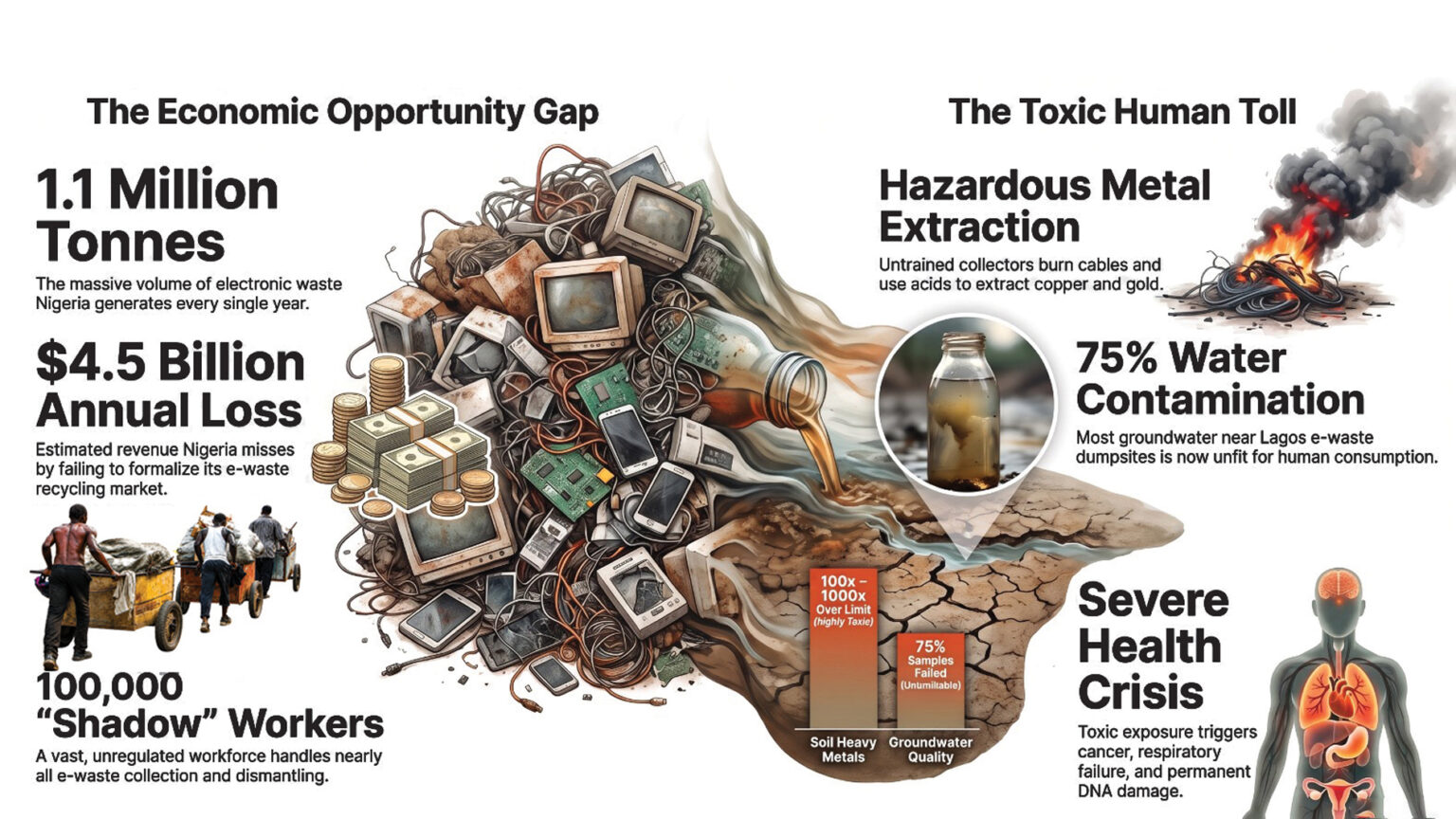
Despite its massive economic potential, Nigeria is completely excluded from the booming $89.48 billion global electronic waste (e-waste) recycling market. Although the country ranks as one of Africa’s largest generators of discarded electronics, the lack of formal management mechanisms has created a severe crisis, resulting in both massive financial losses and escalating environmental degradation.
Data from Precedence Research indicates that the global e-waste recycling industry was valued at $77.61 billion in 2024 and is projected to reach $279.49 billion by 2033, growing at an annual rate of 15.3%. While advanced economies in Asia, Europe, and North America capitalize on this lucrative market through government-mandated recycling and high-tech processing plants, Nigeria and the wider African continent remain left behind.
The Economic Toll and Lost Opportunities
Nigeria generates between 500,000 and 1.1 million tonnes of e-waste annually. Experts estimate that if the country managed to capture just 5% of the global recycling market, it could generate $4.5 billion in annual revenue, create thousands of local jobs, and establish a major export hub for refurbished electronics across West Africa.
A primary driver of this lost wealth is the exportation of printed circuit boards (PCBs), which contain highly valuable precious metals like gold, copper, and palladium. According to the Council for Scientific and Industrial Research (CSIR) in South Africa, Africa currently lacks the capacity for large-scale PCB dismantling. Consequently, these high-value components are shipped directly to Asia and Europe for recovery, stripping local economies of processing profits, manufacturing opportunities, and mineral wealth.
Regulatory Failures and the Rise of "Junk" Imports
The International Telecommunications Union (ITU) reports that while 62 million tonnes of e-waste are generated globally each year, only 22.3% is formally collected and recycled. The ITU emphasizes that nations with strict extended producer responsibility (EPR) laws and electronic regulations achieve significantly higher recovery rates, whereas countries without enforcement hover near 0%.
Nigeria’s e-waste crisis is compounded by both internal demand and external dumping:
-
Economic Pressures: Soaring inflation and a severe cost-of-living crisis have forced millions of Nigerian households to forgo new devices in favor of cheaper, imported second-hand electronics.
-
International Dumping: Developed nations ship over 60,000 tonnes of used electrical and electronic equipment into Lagos ports annually under the guise of narrowing the digital divide. UN tracking studies reveal that a massive portion of these imports arrives as unusable junk.
-
Inadequate Local Infrastructure: The Lagos Waste Management Authority (LAWMA) managed to recycle 405 tonnes of e-waste in 2025. While this is an increase from previous years, it represents less than 0.04% of the national total.
Severe Environmental and Public Health Risks
Because Nigeria lacks certified recycling plants, the management gap is filled by a shadow economy of roughly 100,000 informal scrap dealers, including vulnerable groups like women and children. Operating without protective gear in major Lagos hubs like Ikeja Village and Alaba Market, workers routinely smash cathode ray tubes and burn insulated cables to isolate copper and aluminum.
This primitive processing releases an incredibly toxic cocktail of heavy metals and brominated flame retardants into the ecosystem. Annually, Nigeria dumps or burns more than 52,000 tonnes of brominated plastics and 4,000 tonnes of lead.
A study analyzing groundwater near the Alaba and Olusosun dumpsites discovered that 75% of water samples were entirely unfit for human consumption, showing dangerous levels of lead, cadmium, and nickel that far exceed World Health Organization (WHO) limits. The WHO has warned that chronic exposure to these toxins causes devastating health outcomes, including:
-
Severe respiratory illnesses and chronic coughing
-
Neurological and developmental disorders
-
Miscarriages and DNA damage
-
Various forms of cancer and reduced life expectancy
The Unregulated Shadow Value Chain
The domestic informal trade relies on a vast, untraceable network of roaming door-to-door collectors. These buyers purchase damaged household items and mobile devices from residents for nominal cash fees before passing them to middlemen in industrial scrap zones like Ijora, Lagos. In these zones, components are aggregated, manually dismantled, and sold in bulk to larger buyers or unregulated firms.
This massive network operates completely outside the formal tax and regulatory bracket, relying entirely on undocumented, cash-based transactions with no fixed business addresses or records.
Hidden Security Vulneracies
Beyond environmental and physical health hazards, cybersecurity professionals are warning of an escalating data security threat. Faulty smartphones and laptops sold to informal scrap dealers frequently retain fully functional internal storage systems. Because consumer awareness regarding data destruction remains dangerously low, malicious actors can easily use basic tools to extract personal photos, emails, banking applications, and saved passwords from discarded devices. This regulatory blind spot has directly fueled rising rates of identity theft, unauthorized financial transactions, and online fraud across the region.