


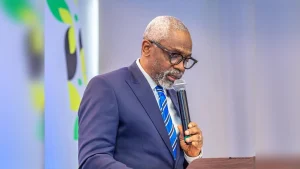
The Committee for the Defence of Human Rights (CDHR) has urged the Federal Government to launch an independent investigation into serious allegations involving the Chief of Staff to the President, Femi Gbajabiamila, and Prince Adeniyi Adeyemi Matthew.
The controversy stems from claims made by Matthew, who alleges that Gbajabiamila demanded 27.4 billion Naira and received 400 million Naira through proxies to secure his appointment as Director-General of the Presidential Foreign Intervention Promotion Council/Presidential Economic Advisory Council. Matthew maintains his appointment was legitimate, pointing to an official letter allegedly issued by the Chief of Staff. Conversely, the Federal Government has accused Matthew of forgery, impersonation, misrepresentation, and operating fraudulent bank accounts.
Call for Temporary Resignation
In a statement signed by National President Yinka Folarin and National Secretary Idris Afees, the CDHR declared that Gbajabiamila should voluntarily step aside from his role while the investigation is conducted. The human rights organization emphasized that this request does not assume guilt, but is instead a standard governance practice necessary to prevent any perception of interference, protect the integrity of the inquiry, and uphold public confidence in state accountability.
The group stressed that public office must not be used for commercial gain or the sale of appointments, asserting that no official should be shielded from scrutiny when facing credible criminal allegations.
Budgetary Discrepancies and Institutional Concerns
The CDHR raised further alarms regarding the institutional systems that allowed the controversial council to function. The group requested that the Department of State Services (DSS) investigate how an entity now labeled by the government as fictitious managed to operate from the Federal Secretariat, interface with state institutions, and secure a multi-billion Naira allocation in the 2026 Appropriation Act.
Consequently, the organization called on the Budget Office of the Federation, the Office of the Accountant-General of the Federation, and the Central Bank of Nigeria to clarify how the council obtained official administrative recognition, Treasury Single Account processing, and budgetary approvals without thorough verification.
Inter-Agency Investigation Urged
Linking the scandal to Nigeria's broader challenges with systemic corruption and its low ranking on Transparency International’s Corruption Perceptions Index, the CDHR noted that financial crimes continue to deprive citizens of vital public infrastructure and services.
To ensure neutrality, the group argued that the Presidency cannot oversee an investigation involving one of its own top officials. They urged a coordinated, impartial probe by the DSS, the Economic and Financial Crimes Commission (EFCC), the Independent Corrupt Practices and Other Related Offences Commission (ICPC), and the Nigeria Police Force.
This position aligns with a similar call from the Chairman of the CDHR Board of Trustees, Femi Falana (SAN), who advocated for equal scrutiny for all involved parties. The CDHR concluded that if the allegations against Matthew are verified, or if any public official is found complicit, the responsible parties must face prosecution under the law regardless of their political status.