


ADC Leadership Tussle Deepens as Nafiu Bala Faction Storms INEC Headquarters
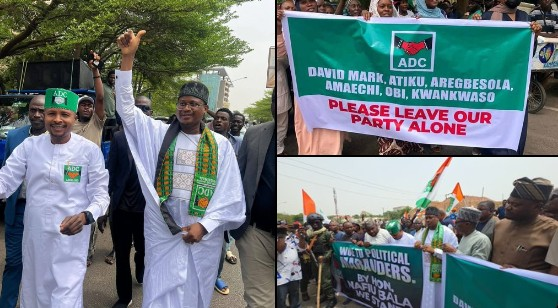
ABUJA – The internal crisis rocking the African Democratic Congress (ADC) intensified on Thursday as factional leader Nafiu Bala led a procession of supporters to the Independent National Electoral Commission (INEC) headquarters, demanding official recognition as the party’s National Chairman.
The demonstration comes just one day after a rival faction, led by former Senate President David Mark, staged a similar protest at the commission's office. The dual demonstrations underscore a deepening schism within the party following the resignation of its long-standing chairman, Ralph Nwosu.
Claims of Judicial Mandate
Addressing the crowd in Abuja, Bala asserted that his claim to the chairmanship is backed by a recent Court of Appeal ruling. He urged INEC to update its records immediately to reflect the court’s decision, arguing that his recognition is vital for the party’s stability and the rule of law.
“The unauthorized attempt to transfer power to David Mark and his associates raises significant concerns regarding the integrity of governance,” Bala stated. “We are calling on INEC to align its official records with the judicial reality of our party's leadership.”
Allegations of Fraud and Forgery
The leadership dispute has shifted from political manoeuvring to accusations of criminal misconduct. Bala alleged that the rival faction employed fraudulent tactics to gain legitimacy, including the forgery of signatures belonging to genuine party leaders.
“These intruders have undermined the democratic process by forging the signatures of ADC members. Such actions erode public confidence in our political institutions and foster a culture of impunity,” Bala told supporters.
INEC Maintains Neutrality
Despite the mounting pressure from both camps, INEC has maintained a cautious stance. The commission indicated it will withhold official recognition of either faction pending a final, definitive judicial resolution.
The ADC, once seen as a third-party alternative in the Nigerian political landscape, now finds itself at a crossroads. As both factions trade accusations of illegitimacy, the party's ability to field candidates and participate in future electoral cycles remains clouded by the ongoing legal and administrative deadlock.