


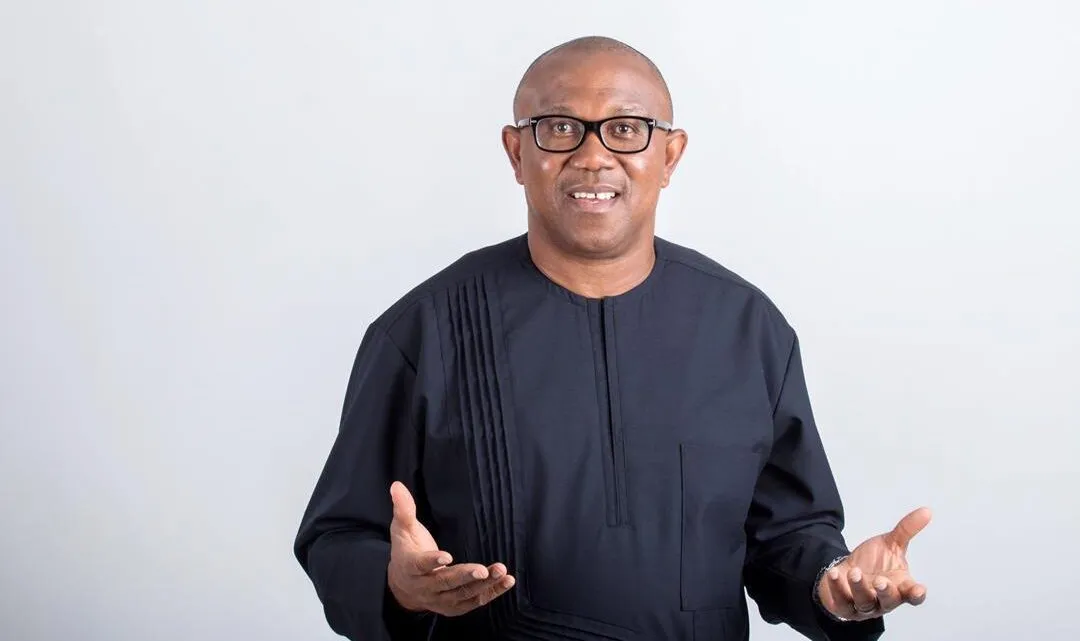
Peter Obi
Discussions surrounding a potential political alliance between former Labour Party presidential candidate Peter Obi and Rabiu Musa Kwankwaso, leader of the Kwankwasiyya movement, are reshaping early conversations ahead of Nigeria's 2027 presidential election.
While neither politician has officially been declared the flagbearer for the newly discussed Nigeria Democratic Congress (NDC), observers increasingly view the duo as a formidable opposition ticket capable of challenging the ruling All Progressives Congress (APC).
Strategic calculations for the proposed partnership are deeply rooted in the electoral data from the 2023 presidential cycle, which highlighted both candidates' significant, yet regionally concentrated, appeal.
The 2023 Electoral Reality
In the 2023 elections, Peter Obi secured over six million votes nationwide under the Labour Party banner, winning 11 states and the Federal Capital Territory (FCT). However, his northern footprint was largely restricted to the North-Central zone, securing victories only in Plateau State, Nasarawa State, and the FCT.
Conversely, Kwankwaso, contesting under the New Nigeria Peoples Party (NNPP), demonstrated immense localized influence by winning Kano State and commanding nearly one million votes, primarily concentrated in the North-West geopolitical zone.
The core question driving current political discourse is whether Kwankwaso’s established northern infrastructure can effectively bridge Obi’s regional deficit in 2027.
Regional Dynamics and Voting Behavior
Speaking on the development, Professor Murtala Muhammad, a political analyst and lecturer at the Aliko Dangote University of Science and Technology, noted that Obi’s 2023 northern appeal was distinct but isolated.
"Peter Obi demonstrated some electoral strength in parts of Northern Nigeria during the 2023 presidential election, particularly in Abuja and among urban youths, middle-class voters, and citizens dissatisfied with the traditional political establishment," Muhammad stated.
However, Muhammad emphasized that the broader data underscores a steep regional divide. Electoral analyses place Obi’s northern vote share at approximately 14%, compared to more than 40% in Southern Nigeria.
According to Muhammad, while a partnership with Kwankwaso would undoubtedly boost competitiveness in Kano and select North-West pockets via the Kwankwasiyya movement, it is unlikely to trigger a sweeping realignment across the wider region. He pointed out that voting behavior in the core North remains heavily mediated by:
-
Religion and regional identity
-
Longstanding political party loyalties
-
Entrenched localized interests
"Consequently, many northern voters may still be reluctant to support Obi despite Kwankwaso’s endorsement," Muhammad argued, cautioning that assuming Kwankwaso can seamlessly transfer his voting bloc to Obi is analytically flawed.
The Path to 2027: Obstacles and Opportunities
Aminu Abdullahi Ibrahim, a Kano-based politician and State House of Assembly aspirant, agreed that Obi's visibility among northern youth, urban demographics, and North-Central Christian communities has grown since 2023. Nevertheless, Ibrahim maintained that the core North-West—including Katsina, Jigawa, Kebbi, Sokoto, and Zamfara—remains a steep hill to climb, where established figures like former Vice President Atiku Abubakar still hold deep-seated influence.
Despite these structural hurdles, Ibrahim conceded that an NDC merger could present a far more formidable opposition front than the fractured field of 2023. However, he stressed that online momentum and cross-regional enthusiasm will not suffice.
"They require strong grassroots mobilization, party unity, trusted local structures, religious and ethnic balancing, and the ability to protect votes across polling units," Ibrahim said. "Even if Obi and Kwankwaso work together, translating public excitement into nationwide electoral victory will still be a major challenge."
Looking Ahead
As coalition talks progress behind closed doors, political analysts agree on one consensus: the viability of an Obi-Kwankwaso ticket relies entirely on their ability to convert distinct regional popularity into a synchronized, nationwide political apparatus capable of navigating Nigeria's complex electoral geography.