


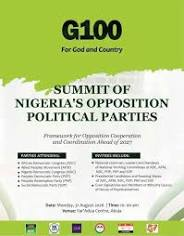
ABUJA: The G100 has proposed the establishment of a Government of National Competence anchored on a single four-year transition term as part of a broader framework for cooperation among Nigeria’s opposition political parties.
The proposal was presented by Mallam Salihu Moh. Lukman on behalf of the G100 at the Summit of Nigeria’s Opposition Political Parties held on Monday at the Shehu Musa Yar’Adua Centre in Abuja.
The summit brought together representatives of the African Democratic Congress (ADC), Allied Peoples Movement (APM), Nigeria Democratic Congress (NDC), Peoples Democratic Party (PDP), Peoples Redemption Party (PRP) and Social Democratic Party (SDP), as well as presidential and vice-presidential candidates and the Minority Leader of the House of Representatives.
At the commencement of the summit, the presidential candidates of the SDP, Prince Adebayo Adewole, and the PRP, Donald Duke, were present, alongside the APM vice-presidential candidate, Lawal Daura. The ADC presidential candidate, Atiku Abubakar, and the NDC presidential candidate, Peter Obi, were still expected at the time proceedings began.
The G100 framework proposes a Government of National Competence based on competence, integrity, national inclusion and equitable representation for participating parties. The proposed administration would operate under a time-bound Four-Year National Reset Programme, backed by a formal and enforceable Transition Charter.
Lukman stressed the need for any agreement reached by the opposition parties to contain clear enforcement mechanisms, arguing that previous political agreements had often been undermined when circumstances or interests changed.
He traced the history of opposition politics since the return to democratic rule in 1999, noting that opposition parties contested the presidency separately in 2003, 2007 and 2011 before achieving a united electoral effort in 2015.
According to the G100, the division of opposition votes in the 2023 presidential election demonstrated the consequences of a fragmented opposition. It noted that the combined votes secured by major opposition candidates exceeded the total received by the eventual winner, describing the outcome as a consequence of opposition disunity rather than an external conspiracy.
As part of the proposed framework, the G100 recommended the creation of three standing coalition bodies. These include a Central Leadership Committee comprising national chairmen, national secretaries, presidential candidates and vice-presidential candidates of participating parties; a Publicity and Communication Committee responsible for coordinating joint messaging; and a Legal Committee to provide legal strategy and advice on coalition matters.
The G100 said it would participate in the proposed structures only as a facilitator and observer, subject to the approval of the political parties involved.
Five working groups are also proposed, with each group expected to include one representative from every participating party. The groups would prepare working papers within four weeks on a National Covenant for Democratic Renewal, a Single-Term Transition Charter, a National Reform Programme, a Framework for Opposition Unity and a Roadmap to a Common Presidential Candidate.
The documents are expected to be presented at a Second Summit for consideration and possible adoption by the participating parties.
The G100 clarified that the Abuja summit was not intended to compel any political party to dissolve or merge, nor was it designed to require any presidential candidate to withdraw from the race. Rather, the immediate objective was to establish a framework through which the parties could negotiate the terms and structure of future cooperation.
Lukman urged the parties to approach the process with openness and a willingness to make compromises, warning that unresolved differences could undermine the coalition-building effort.
He also said the G100 and the Minority Caucus of the House of Representatives convened the summit without endorsing any particular party or presidential candidate.
According to him, the initiative is based on the principle that a functioning democracy requires not only regular elections but also a credible opposition capable of presenting Nigerians with a viable alternative government.
The G100 said the economic and social difficulties facing Nigerians underscore the need for opposition parties to build a serious and credible alternative capable of offering voters a meaningful choice ahead of future elections.