


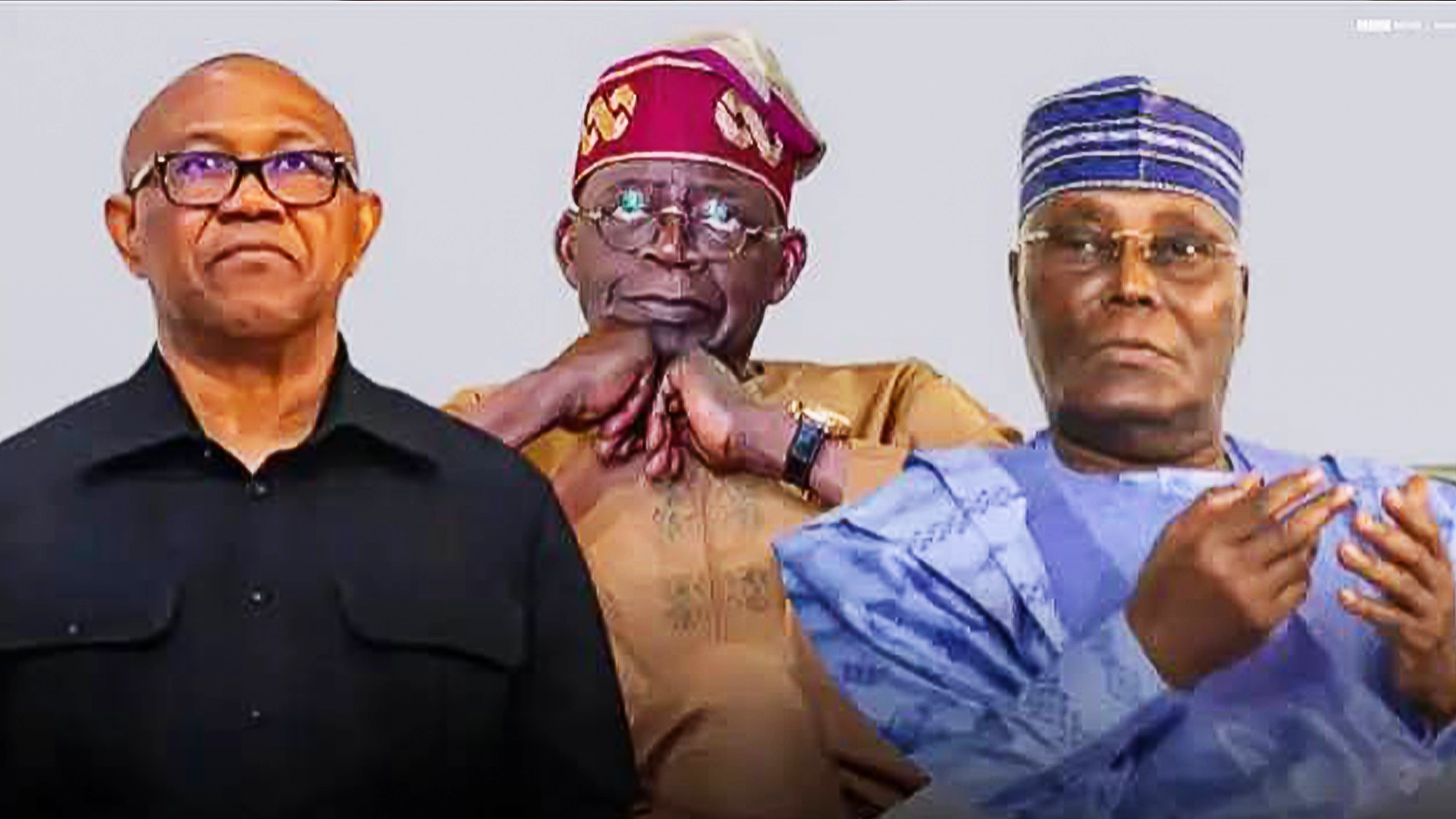
Obi, President Tinubu and Atiku
Nigeria stands at another decisive political crossroads. As the country approaches the 2027 presidential election, the opposition faces a fundamental question: is the objective simply to defeat the ruling All Progressives Congress (APC), or is it to offer Nigerians a genuinely different kind of leadership?
That question is particularly important because the opposition cannot credibly campaign against the failures of the present government while presenting Nigerians with the same political personalities who have dominated presidential politics for decades.
For that reason, there is a strong argument that former Vice President Atiku Abubakar should step aside and allow Peter Obi to emerge as the principal opposition candidate for 2027.
This is not an argument that Atiku has no political experience. He undoubtedly has extensive experience. He served as vice president from 1999 to 2007, has contested the presidency several times, and remains one of Nigeria's most influential opposition politicians. Indeed, the African Democratic Congress (ADC) has already selected him as its 2027 presidential candidate.
But experience alone cannot be the standard by which Nigeria chooses its next president. Nigeria needs renewal, credibility, generational change and a candidate capable of convincing Nigerians that the political system can work differently.
Atiku Abubakar and the Problem of Repeated Presidential Ambition
One of the strongest arguments against another Atiku presidential campaign is the perception that his political ambition has become almost permanent.
Atiku has contested the presidency repeatedly, including in 2007, 2019 and 2023, and he is now preparing for another presidential contest in 2027. His persistence demonstrates political determination, but it also raises a legitimate question: when does personal ambition become an obstacle to political renewal?
Nigeria is a country of more than 200 million people, with millions of younger citizens who have never had a meaningful opportunity to see a new generation of national leadership.
A presidential candidate should therefore be prepared to recognize when the national interest may require stepping aside.
Atiku himself has spoken in support of rotational presidency. In April 2026, he said that, if elected, he would seek to make presidential rotation a constitutional principle.
That position creates an important political question. If rotation between North and South is desirable enough to be written into the Constitution, why should the principle not also inform the political decisions of opposition leaders today?
Nigeria's zoning arrangement is not a constitutional requirement, and no Nigerian citizen is legally prohibited from contesting the presidency because of geography. Nevertheless, zoning and rotation have become important political conventions used by major parties to manage Nigeria's deep regional, ethnic and religious diversity.
The PDP, for example, has historically embraced rotation and zoning as mechanisms for promoting what its constitution describes as equity, justice and fairness.
Consequently, Atiku's decision to seek the presidency again from the North, despite widespread arguments that the presidency should return to the South in 2027, can reasonably be criticized as politically insensitive to the country's established power-sharing expectations.
It does not mean that Atiku has violated a constitutional rule. Rather, the criticism is that he is choosing personal political ambition over an important informal convention intended to maintain national balance.
The North-South Question Cannot Simply Be Ignored
Nigeria's political history makes regional balance particularly sensitive.
The presidency has frequently been managed through informal understandings between political blocs. These arrangements are imperfect, sometimes controversial and certainly not a substitute for constitutional democracy. But they exist because Nigeria's political leaders understand that the country is too diverse for one region to permanently dominate the presidency.
After President Muhammadu Buhari's two terms from 2015 to 2023, the presidency moved to the South when Bola Ahmed Tinubu won the 2023 election.
That development created an expectation among many Nigerians that the next major opposition presidential candidate should also recognize the importance of regional balance.
The argument for Peter Obi therefore goes beyond the question of whether he is from the South. It is about whether the opposition can demonstrate that it understands the importance of fairness, rotation and national inclusion.
Interestingly, in May 2026, the Nigeria Democratic Congress (NDC) formally zoned its 2027 presidential ticket to the South and allocated the 2031 ticket to the North. The party explicitly presented the arrangement as a mechanism for fairness, balance and rotation.
That arrangement strengthens the argument that 2027 should be viewed as an opportunity for a southern candidate to lead the opposition.
Why Atiku Should Step Aside for Peter Obi
The most important reason is not Atiku's age, region or length of political career. It is the need for political renewal.
Atiku has already had several opportunities to become president. He was vice president for eight years and subsequently sought the presidency repeatedly. Yet Nigerians have continued to reject his presidential bids.
That electoral history should matter.
In the 2023 election, Bola Tinubu won, Atiku finished second and Peter Obi finished third. Obi's performance was particularly significant because he emerged from a relatively smaller political platform and built an enormous grassroots movement, particularly among younger Nigerians.
Rather than continuing an old political contest between established northern and southern political elites, the opposition should consider whether 2027 is the moment to put forward a candidate associated with a different political generation.
That candidate, in my view, should be Peter Obi.
The Corruption Question and Atiku's Trust Deficit
Any serious discussion of Atiku's political career must also address the corruption allegations that have surrounded him.
Atiku has faced corruption allegations for many years, including allegations connected to his period as vice president and controversies surrounding the U.S. investigation involving Congressman William Jefferson. In 2007, Nigeria's anti-corruption agency, the EFCC, included Atiku among politicians it accused of corruption, while Atiku and his political allies rejected the allegations.
The Jefferson affair also attracted extensive attention in the United States. Contemporary reporting described allegations concerning relationships between Jefferson, Nigerian interests and people associated with Atiku. Atiku denied wrongdoing.
It is important to be precise here: allegations are not the same thing as convictions. Atiku should not be described as legally proven to be corrupt simply because allegations were made against him. Indeed, in 2007, Nigeria's Supreme Court overturned the electoral commission's attempt to disqualify him from the presidential election on the basis of the corruption allegations.
However, politics is also about public confidence.
The central problem is therefore the trust deficit surrounding Atiku. A presidential candidate does not need to have been convicted of corruption for voters to question whether he represents the clean break from Nigeria's old political culture that the country desperately needs.
For many Nigerians, the issue is not merely whether Atiku can legally contest. The question is whether he can convincingly campaign as the person who will dismantle the networks of patronage, corruption and political privilege that have contributed to Nigeria's governance problems.
That is a much more difficult political proposition.
Atiku's Long Political Career Is Both His Strength and His Weakness
Atiku's supporters will argue that his experience is precisely why he should be president.
But experience can become a liability when voters associate a politician with the very political establishment they want to change.
Atiku was part of the political establishment for decades. He was vice president during the Obasanjo administration and later became one of the most prominent figures in opposition politics.
This means that when Nigerians complain about corruption, poor institutions, unemployment, poverty and political patronage, Atiku cannot present himself entirely as an outsider to the system.
The opposition needs someone who can say:
"I understand the system, but I am prepared to change it."
Peter Obi has a stronger political argument on this point.
He is also an experienced politician and former governor of Anambra State, so he cannot honestly be portrayed as completely outside the establishment. But compared with the traditional presidential figures who have dominated Nigeria's national politics, Obi represents a generational and political alternative.
Peter Obi Represents a Different Political Proposition
Peter Obi's greatest political asset is not that he is perfect. No politician is.
His greatest asset is that he has succeeded in turning the demand for a different political culture into a powerful national movement.
His 2023 presidential campaign demonstrated that Nigerians, particularly younger voters, were willing to reject the traditional two-party structure and seriously consider an alternative.
Obi's supporters have built a movement around ideas such as prudent public spending, accountability, productive investment, human capital development, education, healthcare, employment and economic production.
That message resonates with a generation of Nigerians who do not want another president whose primary political qualification is the ability to mobilize traditional political structures.
They want a president who can explain how Nigeria will create jobs, improve education, reduce poverty, attract productive investment and make government accountable.
Obi's Four-Year Argument Is Particularly Important
There is another reason Obi's candidacy deserves serious consideration.
During the opposition realignment, Obi indicated that he would accept a four-year arrangement if that were necessary to secure an agreement on rotational leadership. Reporting in 2025 quoted him as saying he would comply with an agreement that restricted him to one four-year term and leave office in 2031.
That is politically significant.
Imagine an opposition coalition agreeing on the following principle:
Peter Obi leads for four years from 2027 to 2031, after which the presidency returns to the North.
Such an arrangement could address one of the major concerns surrounding Nigeria's political instability: the struggle among regional blocs over who gets the presidency.
It would also give Nigeria the opportunity to elect a southern president in 2027 while assuring northern political stakeholders that they would not be permanently excluded.
The NDC's 2026 zoning decision, which places the South in 2027 and the North in 2031, demonstrates that such a framework is already being discussed within opposition politics.
Tinubu's Government Has Failed to Convince Millions of Nigerians
The case for an opposition alternative becomes even stronger when the condition of the Nigerian economy is considered.
President Bola Tinubu's government inherited serious structural problems, but after more than three years in office, Nigerians have every right to ask whether the sacrifices demanded of them are producing meaningful improvements in their daily lives.
The government's removal of the petrol subsidy and liberalisation of the naira were presented as necessary reforms. International institutions have acknowledged improvements in some macroeconomic indicators and investor confidence.
But macroeconomic improvement is not the same thing as improved living standards.
The International Monetary Fund reported in June 2026 that Nigeria's poverty rate remained around 63 percent and estimated that 27 million Nigerians faced food insecurity in late 2025. It also projected economic growth of about 4.1 percent for 2026.
Recent reporting similarly shows that Nigerians continue to experience severe cost-of-living pressures, with food and fuel prices remaining major burdens on households.
Therefore, the opposition has a legitimate argument to make:
Economic reforms must ultimately be measured by what happens to ordinary people.
If families cannot afford food, young people cannot find decent employment, businesses cannot survive, and millions remain trapped in poverty, government cannot simply point to improved economic statistics and declare victory.
Corruption Allegations Under Tinubu Also Strengthen the Opposition's Case
The Tinubu administration has also faced serious allegations and controversies involving public spending, procurement and corruption.
One recent controversy involved the discovery of a fictitious agency included in Nigeria's federal budget with a ₦1.3 billion allocation and additional proposed funding. The affair generated criticism about weaknesses in budgetary oversight and accountability. Allegations were also made against the president's chief of staff, who denied them.
Again, allegations must not automatically be treated as proven criminal conduct.
But Nigerians are entitled to demand something more than accusations and denials. They deserve institutions capable of investigating allegations independently and transparently.
That is why the opposition's message should not simply be:
"Tinubu is bad."
It should be:
"Nigeria deserves a government in which public money is protected, institutions are independent, corruption allegations are investigated without political interference, and nobody is above accountability."
Nigeria's Youths Need a Political Future
Perhaps the strongest reason for a new political direction is Nigeria's young population.
Millions of young Nigerians are educated but unemployed or underemployed. Others are leaving the country because they believe their future is brighter elsewhere.
A country with Nigeria's enormous population, natural resources, entrepreneurial energy and human capital cannot continue operating an economy in which young people feel that their best option is to leave.
The 2027 election should therefore be about more than personalities.
It should be about whether Nigeria can build an economy that produces:
- productive employment;
- affordable and reliable electricity;
- quality education;
- functional healthcare;
- modern infrastructure;
- agricultural productivity;
- technology and innovation;
- support for small businesses;
- industrial development; and
- opportunities for young Nigerians to build successful lives at home.
Peter Obi's political message has consistently emphasized investment, production, human capital and reducing waste in government. Whether one agrees with every element of his programme or not, that is the kind of policy conversation Nigeria needs.
The Opposition Must Avoid Repeating the Mistakes of the Past
The greatest danger to the Nigerian opposition is fragmentation.
Atiku's emergence as the ADC candidate demonstrates that the opposition remains divided over strategy and leadership. The ADC submitted Atiku's candidacy to INEC and subsequently selected Rotimi Amaechi as his running mate.
If the opposition parties enter 2027 with multiple presidential candidates dividing anti-APC votes, Tinubu's political advantage could increase.
The opposition therefore needs to ask a simple question:
Who is most capable of bringing together Nigerians who want change?
The answer should not be determined by who has the largest political machine, the deepest political network or the longest résumé.
It should be determined by who can inspire Nigerians across regional, ethnic, religious and generational boundaries.
That is where Peter Obi has a compelling argument.
Atiku Should Put Nigeria Before Personal Ambition
Stepping aside would not mean that Atiku has failed.
On the contrary, it could become one of the most important political decisions of his career.
A statesman is not measured only by how many times he contests for power. He is also measured by whether he knows when to subordinate personal ambition to the larger national interest.
Atiku has already demonstrated that he can play an important role in Nigerian politics. He can remain a senior opposition figure, statesman, adviser and coalition-builder without necessarily being the presidential candidate.
His support for Peter Obi could dramatically change the political equation.
Imagine Atiku telling Nigerians:
"I have contested before. I have served as vice president. I have contributed my part to Nigerian politics. For the sake of national unity and generational change, I will support Peter Obi in 2027."
That would be a powerful political statement.
It would show that the opposition is not simply another group of politicians fighting for the presidency.
It would show that Nigeria comes first.
Peter Obi as the 2027 Opposition Option
Peter Obi should therefore be considered not merely because he is from the South, but because he represents the possibility of a different political era.
He has already demonstrated substantial national appeal. His 2023 campaign broke the traditional expectation that presidential politics in Nigeria must be dominated by the APC and PDP. He developed particularly strong support among younger voters and demonstrated that an alternative political movement could become a serious national force.
The NDC's decision in May 2026 to zone its 2027 presidential ticket to the South further strengthens his position. Reports indicated that the arrangement was widely viewed as improving Obi's prospects.
That does not mean Obi should be treated as a messiah or as a politician incapable of making mistakes.
Nigeria does not need another messianic political culture.
Nigeria needs institutions, accountability, competence and leadership that respects the Nigerian people.
Peter Obi should therefore be judged on his policies, record, competence, integrity and ability to build a national government—not simply on the enthusiasm of his supporters.
Conclusion: 2027 Must Be About a New Nigeria
Nigeria cannot continue moving from one political cycle to another with essentially the same political formulas.
Atiku Abubakar has had his opportunity to lead the country at the presidential level. His long political career and repeated presidential campaigns have made him one of Nigeria's most recognizable opposition figures. But the repeated pursuit of the presidency has also created questions about whether personal ambition is being placed above political rotation, generational change and national consensus.
The allegations that have surrounded his career, although not equivalent to criminal convictions, have also created a significant trust problem that would make it difficult for him to convincingly present himself as the clean break Nigeria needs.
At the same time, Tinubu's government is facing enormous public dissatisfaction over the cost of living, poverty, food insecurity and the perceived failure of economic reforms to improve everyday life. Nigeria also continues to face serious concerns about corruption and public accountability.
The answer, therefore, should not be to return to the politics of the past.
The answer should be political renewal.
For the 2027 election, Peter Obi offers the opposition an opportunity to present Nigerians with a southern candidate, a different generation of leadership, a strong appeal to young people and a political platform centered on competence, accountability, production and national development.
If Atiku truly believes in rotational presidency and national unity, the most powerful demonstration of that belief would be to step aside and support a southern candidate.
Peter Obi should be given the opportunity to lead the opposition in 2027.
Not because he is perfect.
Not because every Nigerian must support him.
But because Nigeria deserves the opportunity to choose something different.
The 2027 election should not be a contest over which old political establishment can return to power.
It should be a referendum on whether Nigeria is ready for generational change, accountable government, economic opportunity and a new political direction.
After years of disappointment, corruption allegations, economic hardship, unemployment and declining public confidence, Nigerians deserve a genuine alternative.
In my view, Peter Obi is the strongest and most credible opposition option for that alternative in 2027.
The task before Nigeria's opposition is therefore clear: put the country before individual ambition, unite around a credible candidate, respect the principle of political rotation, and give Nigerians the opportunity to vote for a new direction.
2027 should be about Nigeria not Atiku, not Tinubu, and not any individual's lifelong presidential ambition. It should be about the future of the Nigerian people.