


United States military forces executed a seventh consecutive night of airstrikes against targets in Iran following the formal termination of a temporary ceasefire agreement.
According to military officials, the operations utilized fighter aircraft, unmanned aerial drones, and warships to target specific strategic locations. The strikes focused on Iranian military logistics infrastructure, surveillance installations, underground weapons storage facilities, and maritime assets. The operation concluded after several hours of sustained engagement.
Regional Escalation and Counter-Strikes
In response to the American offensive, Iranian forces launched retaliatory missile and drone attacks directed at U.S. allies throughout the region.
-
Kuwait: Air defense systems were deployed to intercept multiple incoming missile and drone strikes. Officials confirmed that earlier waves of drone attacks damaged a power plant and water desalination facilities, resulting in injuries to several Kuwaiti soldiers.
-
Jordan: Armed forces successfully intercepted ten Iranian missiles violating its airspace. Reports indicate no significant damage from the overnight interceptions, though previous engagements over the past week at two Jordanian bases resulted in injuries to several U.S. service members.
-
Syria: Iranian authorities claimed to have expanded their operations to target U.S. military installations within Syria for the first time, alongside actions in Bahrain. U.S. officials have denied these specific claims.
Strategic Infrastructure and Shipping Disruption
The ongoing conflict has severely impacted commercial maritime activity in the Strait of Hormuz, a critical global shipping lane responsible for approximately 20% of the world's oil and liquefied natural gas supplies. Shipping traffic through the waterway has ground to a near-total standstill due to the persistent hostilities.
Explosions were confirmed in Iran's central city of Yazd, as well as on Qeshm Island and at the port of Bandar Abbas, located adjacent to the strait.
Conflicting reports emerged regarding maritime incidents within the corridor. Iranian state media reported that two oil tankers suffered explosions and fires after navigating a mined route south of the Strait of Hormuz. U.S. Central Command subsequently dismissed the claim as inaccurate.
Casualties and Damage Assessment
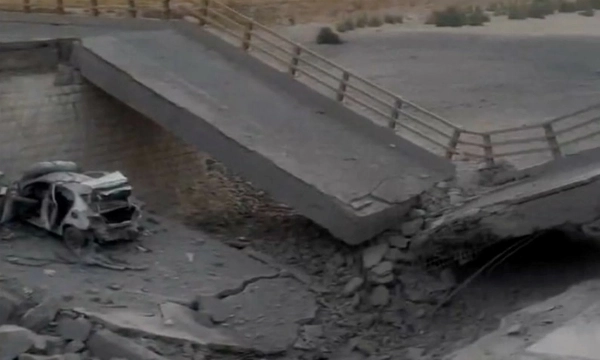
Disputes remain over the nature of the targets hit within Iran. Local provincial authorities in the heavily impacted Hormozgan province reported seven fatalities and alleged that civilian infrastructure—including bridges, a railway station, and an airport—had been struck.
Independent visual verification confirmed severe structural damage to the Gariveh Bridge, with daylight imagery revealing a collapsed section of the roadway.
The White House maintained that all operations were strictly confined to military targets and logistics infrastructure, denying any intentional targeting of civilian facilities. The escalation marks one full week of nightly engagements following the collapse of peace talks, which broke down over disagreements regarding security and access within the Strait of Hormuz.