


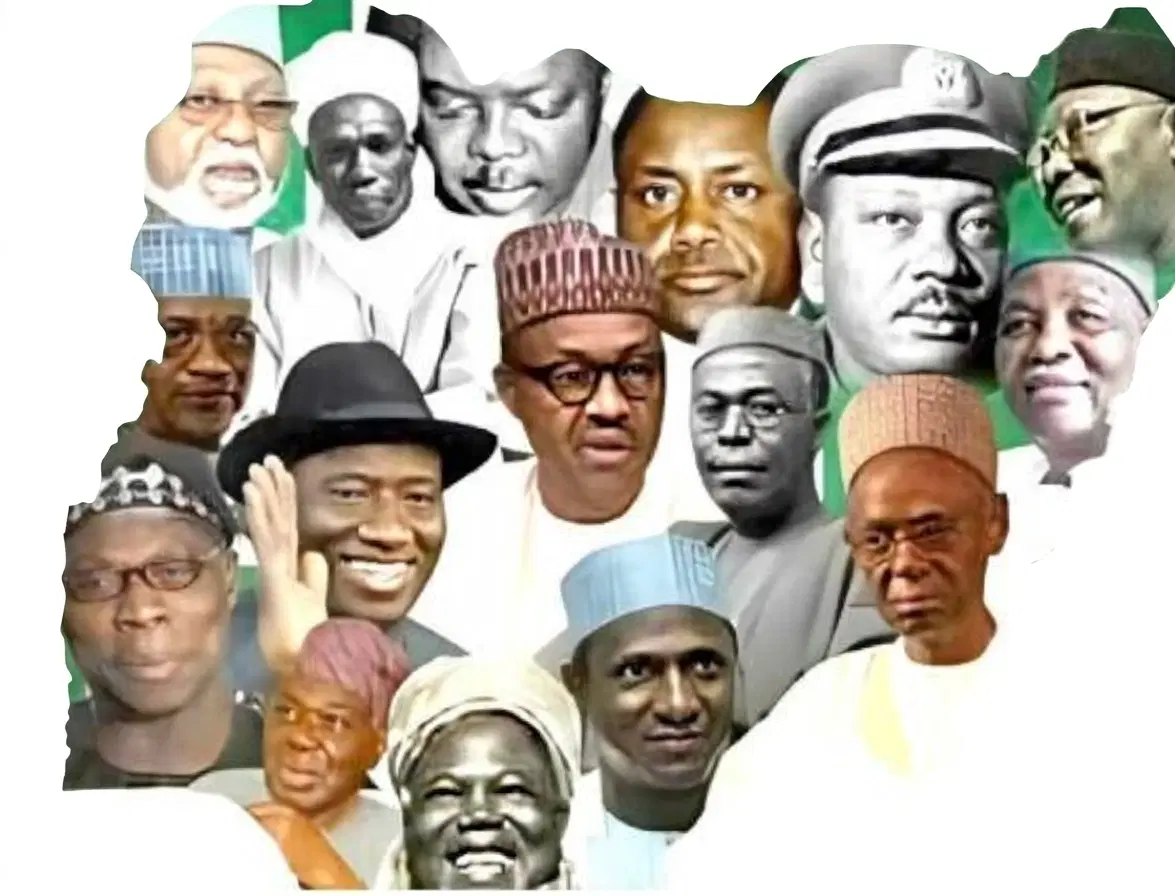
The contrast between Nigeria at its independence in 1960 and the nation today is staggering. In 1960, individuals prosecuted for embezzlement would never have been fielded by any political party. Today, suspected criminals, certificate forgers, and financiers of illicit networks routinely run for high office.
Similarly, no university graduate in 1960 would have considered crime as a primary career option. Today, thousands of graduates join cybercrime ("yahoo") syndicates to fund lavish lifestyles—a choice fueled by a profound lack of remorse among political leaders accused of serious corruption. The nation's founding fathers—Ahmadu Bello, Nnamdi Azikiwe, and Obafemi Awolowo—would scarcely recognize the country today, as public infrastructure, governance, and the social fabric remain in deep decline.
1. Food Security: From Net Exporter to Scarcity
“There are people in the world, so hungry, that God cannot appear to them except in form of bread.” — Mahatma Gandhi
In 1960, Nigeria was a net exporter of food, supplying vegetable oil and cocoa to the global market while importing zero rice. This was achieved at a time when literacy rates were minimal and the university system was in its infancy.
Today, with over 120,000 graduates entering the job market annually, Nigeria struggles to feed its population. It remains heavily reliant on food imports. According to the Federal Ministry of Agriculture and Food Security, national fertilizer consumption sits at 18.6 kg per hectare, falling drastically short of the 50 kg benchmark established by the 2006 Abuja Declaration. Sustainable food security remains a distant mirage.
2. Intractable Multi-Dimensional Poverty
Nigeria's economic trajectory has suffered a relentless decline from a promising Middle-Income status in the decades following independence to a global poverty hotspot.
-
The Numbers: The poverty count rose from roughly 18 million in the 1960s to 133 million in 2022, reaching approximately 138 million by 2025.
-
Current Pressures: This figure continues to climb under the weight of sweeping economic reforms, notably the removal of fuel subsidies, which have deepened economic hardships for millions.
3. The Collapse of Crude Oil Refining
The 1970s and early 1980s marked the golden era of Nigeria's oil sector, when the nation stood as one of the world's top crude exporters and maintained functional domestic refineries.
The system stalled when routine Turn-Around-Maintenance (TAM) was abandoned, leaving local refineries in complete ruin. Today, despite the operations of the Dangote Refinery, Nigeria finds itself importing refined products and crude variants, entirely reversing its former industrial dominance.
4. Healthcare in Critical Condition
“Health is wealth.”
Public healthcare has deteriorated to alarming levels. General hospitals lack basic funding, and the patient-to-doctor ratio has ballooned to roughly 300,000 patients per doctor, making it one of the worst ratios globally.
Capital budget releases for health remain exceptionally low—evidenced by a mere fraction of the 2025 health capital budget being disbursed. Consequently, medical infrastructure remains obsolete, staff morale is low, and Nigeria continues to record stagnant life expectancy rates.
5. Soaring Unemployment and Tech-Enabled Crime
With hundreds of thousands of graduates completing the National Youth Service Corps (NYSC) annually only to face joblessness, international crime syndicates have found a ready workforce.
Cybercrime, romance scams, transnational money laundering, and drug trafficking have proliferated across the country, with some syndicates operating directly from prison walls. Law enforcement continues to struggle to keep pace with these evolving financial crimes.
6. Pervasive Public Sector Corruption
According to recent disclosures by the Economic and Financial Crimes Commission (EFCC), embezzlement and asset accumulation by public servants remain widespread. Audits from the Auditor-General of the Federation regularly highlight multi-trillion-naira questionable transactions across Ministries, Departments, and Agencies (MDAs), with major institutional bodies heavily implicated.
Furthermore, a significant portion of national borrowing intended for welfare improvement and poverty reduction has been compromised by systemic public sector larceny.
7. The Mounting Debt Burden
Nigeria's total debt profile climbed to N166.79 trillion by mid-2026. Successive administrations have maintained an unyielding reliance on external and domestic borrowing.
The current administration has accumulated debt at an unprecedented pace, mortgaging the future for generations to come while ordinary citizens bear the cost through deepening poverty and minimal tangible infrastructural returns.
8. Escalating Security Crises and Displaced Persons
Security challenges have escalated dramatically since the 2010s, with non-state actors frequently challenging the state's monopoly on force.
-
Data from early 2026 indicates approximately 3.7 million internally displaced persons (IDPs) across the country.
-
Borno State and Benue State alone account for roughly 60% of all displaced individuals.
-
Mass murders, kidnappings, and community destructions continue to disrupt daily life, with security responses remaining severely constrained.
9. Budgetary Process and Governance Deficits
Annual federal budgets have increasingly suffered from poor implementation, delayed legislative processing, and severe funding shortfalls. Past revelations of massive, unauthorized withdrawals from the Central Bank of Nigeria (CBN) without legislative approval exposed deep institutional vulnerabilities that continue to plague fiscal management.
10. The Rise of Illicit Drug Production
Originally categorized primarily as a drug-transit nation upon the creation of the National Drug Law Enforcement Agency (NDLEA) in 1989, Nigeria has transformed into a high consumer, producer, and exporter of illicit substances. Despite active enforcement operations, the discovery of multi-billion-dollar local drug-producing factories highlights an uphill battle against pervasive drug abuse extending even into primary schools.
11. International Diplomacy and Executive Absence
President Tinubu's continued absence from major international platforms, such as the United Nations General Assembly (UNGA), has drawn sharp criticism and speculation regarding foreign legal hurdles and diplomatic engagements. Such absences distance Nigeria from crucial global networking and multilateral cooperation opportunities that past heads of state routinely prioritized.
From food scarcity and systemic corruption to mounting debt and security deficits, Nigeria faces a complex web of structural challenges. Reversing this trajectory requires rigorous institutional reform, transparent fiscal management, and a decisive commitment to public welfare over political expediency.