


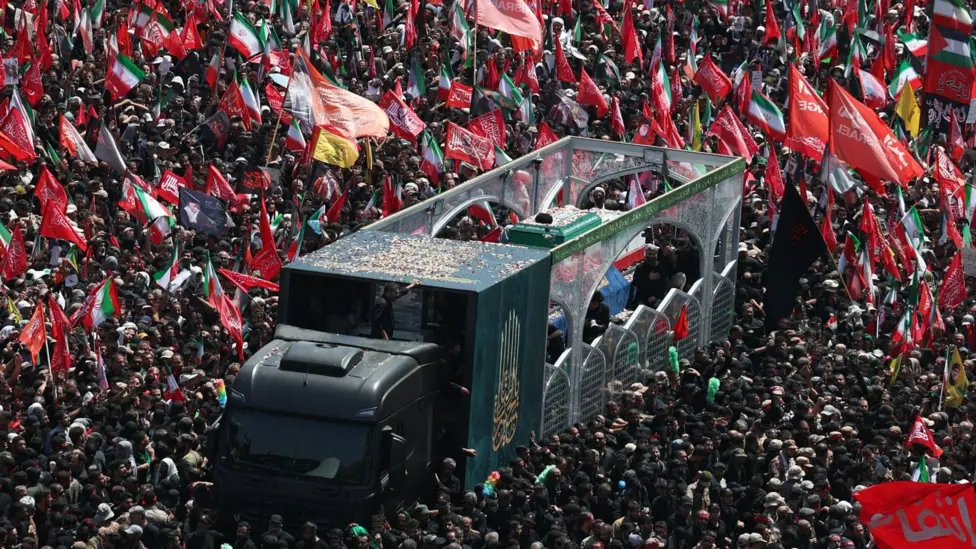
TEHRAN: Massive crowds filled the streets of the Iranian capital for the funeral procession of the country's late supreme leader, Ayatollah Ali Khamenei, who was killed during the opening days of the recent conflict involving the United States and Israel.
According to Iranian state television, tens of thousands of mourners assembled along a 10-kilometer (6-mile) route through central Tehran to observe the transfer of Khamenei’s flag-draped coffin. The procession, which marked the final day of a three-day public mourning period, traveled from Imam Hossein Square to Azadi Square, passing through the landmark Enghelab Square.
The public procession followed a two-day lying-in-state period at Tehran's Grand Mosalla mosque. While three of Khamenei's sons attended the initial services, his son and successor as supreme leader, Mojtaba, did not appear. Mojtaba has not been seen publicly since sustaining serious injuries in the February 28 Israeli airstrike that killed his father and wife.
Public Demonstrations and Political Presence
State media reported that millions of citizens crowded the main boulevards surrounding the transport vehicle, which carried the coffins of the late supreme leader and four family members. Participants displayed national flags, symbolic red banners, and placards expressing anti-American and anti-Israeli sentiments, specifically targeting U.S. President Donald Trump and Israeli Prime Minister Benjamin Netanyahu, who jointly authorized the military actions four months ago.
Several prominent political figures attended the proceedings, including Iran's current president, Masoud Pezeshkian, and former president Mahmoud Ahmadinejad, marking the latter's first major public appearance since the outbreak of hostilities. President Pezeshkian emphasized national unity in a statement published on social media, pledging to maintain the nation's trajectory toward progress and honor.
Geopolitical Context and Diplomatic Response
In response to the events, Israeli Defense Minister Israel Katz confirmed Israel's responsibility for the strike, citing existential threats as the justification for the military action, and issued a warning to future Iranian leadership against pursuing hostile agendas toward Israel.
The funeral ceremonies occur less than three weeks after Iran and the United States entered into a preliminary agreement to halt the conflict and reopen the strategic Strait of Hormuz, a vital maritime corridor handling approximately 20% of global oil and gas shipments. The agreement establishes a two-month window to negotiate a comprehensive resolution addressing Iran's nuclear program, U.S. economic sanctions, and a permanent ceasefire.
Diplomatic mediators in Qatar reported constructive advancements during indirect discussions held in Doha last week. The next round of bilateral negotiations is scheduled to resume following the conclusion of the memorial events.
Scheduled Memorial Timeline
The multi-day funerary proceedings will continue across the region:
-
Tuesday: A procession and clerical prayers in the city of Qom.
-
Wednesday: Observances in the Iraqi shrine cities of Karbala and Najaf.
-
Thursday: The final burial of Ayatollah Ali Khamenei at the Imam Reza shrine in his hometown of Mashhad.