


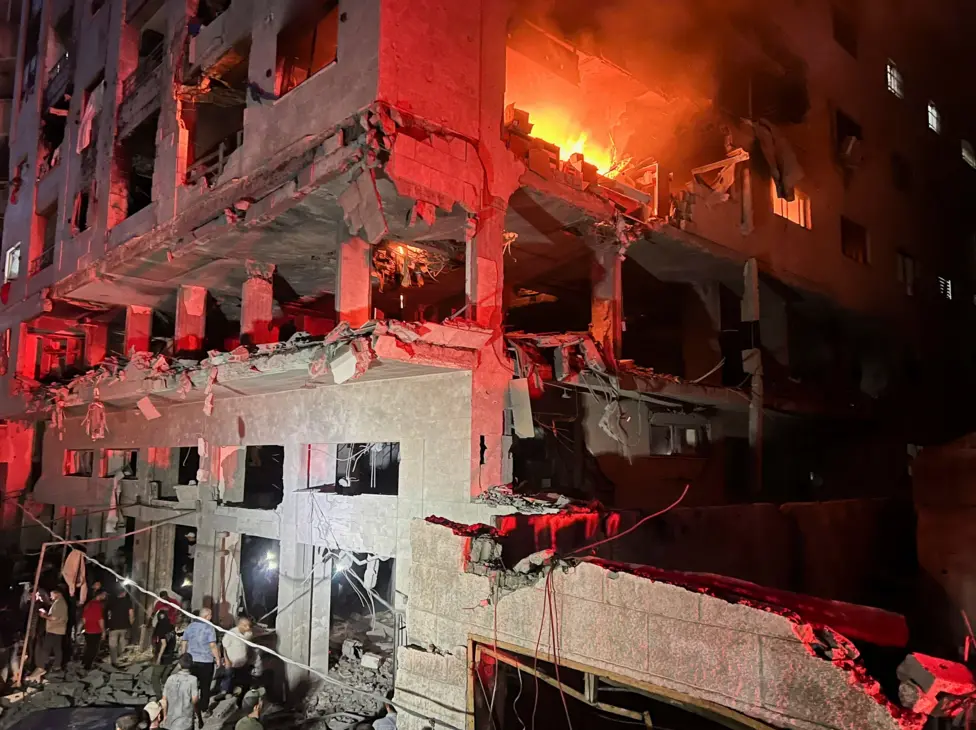
A senior Hamas official has confirmed to the BBC that Izz ad-Din al-Haddad, a top commander within the group's armed wing, was killed Friday in an Israeli air strike in Gaza City.
In a joint statement, Israeli Prime Minister Benjamin Netanyahu and Defence Minister Israel Katz stated that Haddad was "one of the architects of the October 7 massacre" and held him "responsible for the murder, kidnapping, and injury of thousands of Israeli civilians and IDF soldiers." The statement further noted that Haddad had refused to comply with the US-led agreement to disarm Hamas and demilitarize the Gaza Strip.
Details of the Operation
According to eyewitness accounts, the operation involved two distinct strikes:
The Initial Strike: Three missiles were launched simultaneously from two directions, striking the Al-Mu'taz residential building in central Gaza City. The strike ignited a large fire, complicating evacuation and rescue efforts. Local sources reported that armed Hamas members in civilian clothing subsequently evacuated a severely wounded individual through a side entrance into a waiting vehicle.
The Secondary Strike: Approximately 1.5 kilometers (0.9 miles) from the apartment block, Israeli forces targeted the fleeing vehicle. Sources indicate the car was believed to be transporting the injured commander. Three individuals were reported killed in the vehicle strike.
A senior Israeli security official stated that preliminary intelligence confirmed Haddad was successfully targeted.
Fragile Ceasefire and Stalled Peace Talks
The operation is the latest in a series of targeted strikes conducted by Israel since a ceasefire agreement took effect on October 10. The geopolitical situation remains complex:
Accusations of Violations: Hamas has repeatedly accused Israel of breaching the ceasefire terms and targeting civilians. Conversely, the Israeli government maintains it retains the authority to target active Hamas operatives, accusing the group of violating the agreement by refusing to disarm.
Stalled Diplomatic Efforts: US-led peace initiatives have faced significant delays, particularly following the outbreak of the Iran war. While the US announced the transition to the second phase of the peace plan in January—intended to establish a transitional technocratic administration alongside the demilitarization and reconstruction of Gaza—talks regarding disarmament remain deadlocked. Observers note that Hamas has recently reactivated its police force and begun reasserting local authority.
Conflict Context
The war began following the Hamas-led attacks on southern Israel on October 7, 2023, which resulted in the deaths of approximately 1,200 people and the abduction of 251 hostages.
According to the Hamas-run health ministry, Israel's subsequent military campaign in Gaza has resulted in more than 72,744 fatalities, with 857 of those deaths reported to have occurred after the October ceasefire came into effect.