


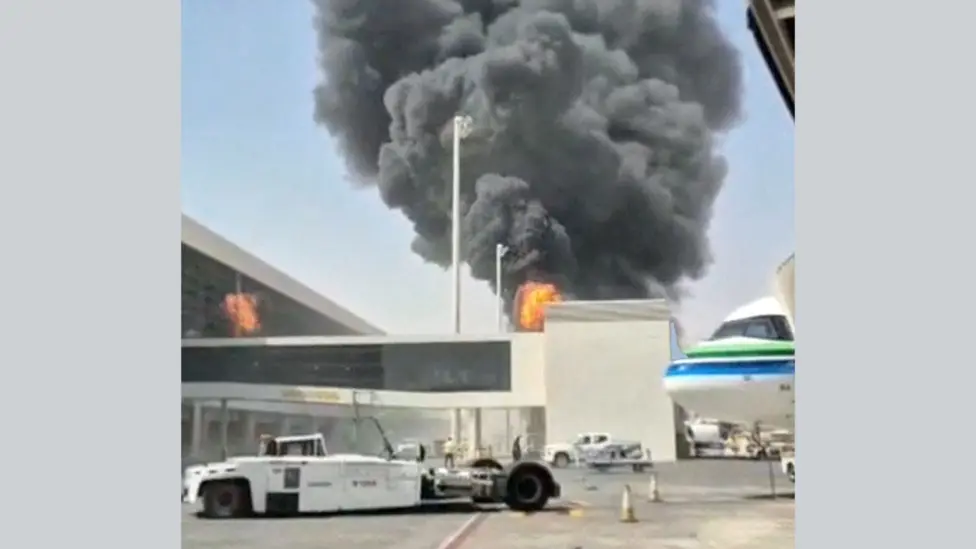
Three Saudi Arabian nationals have been killed in two attacks targeting King Khalid International Airport in Riyadh, according to the country's civil aviation authority, following claims by Yemen's Houthi movement that it had launched missile strikes against the facility.
The attacks also left several Saudi citizens and foreign residents injured, the General Authority of Civil Aviation said in a statement. The incidents occurred on Thursday, with the first attack targeting the airport and the second striking an aircraft operated by Saudi Arabia's national carrier, Saudia.
The airline confirmed that one of its pilots was among those killed in the attacks. Authorities later reported that air traffic at the airport had returned to normal.
Yemen's Houthi movement claimed responsibility for launching two ballistic missiles at Riyadh airport. The group also said it had targeted an airport in Najran, near the Saudi-Yemeni border, as well as Khamis Mushait air base farther north. Saudi authorities have not confirmed the reported attacks on those additional locations.
Latest Attacks Follow Deadly Strikes on Saudi Airports
The latest casualties come days after separate Houthi attacks on two Saudi airports on 6 and 7 October, which killed three people and injured dozens of others.
According to the civil aviation authority, two people were killed and 28 others wounded in an attack on Abha International Airport on Wednesday. Another person was killed in an earlier attack involving King Khalid International Airport in Riyadh.
The successive incidents highlight the growing security threat facing Saudi Arabia as hostilities intensify between the country's military and the Houthis, who control large parts of north-western Yemen.
The Houthi movement has said its attacks on Saudi airports are retaliation for Riyadh's military support for Yemen's internationally recognised government. The group has also accused Saudi Arabia of conducting military operations against Houthi-controlled areas.
Escalating Conflict Raises Regional Security Concerns
The latest strikes come amid a renewed escalation in Yemen's long-running conflict between government forces backed by Saudi Arabia and the Iran-aligned Houthi movement.
The Houthis have intensified their military operations in recent weeks, including an offensive that captured strategically important sections of Yemen's Red Sea coastline. Their advance included the port of Mokha, located near the Bab al-Mandab Strait, a critical maritime passage connecting the Red Sea with the Gulf of Aden.
The Bab al-Mandab Strait is one of the world's most important shipping chokepoints, serving as a key route for international trade and energy shipments. Any disruption to maritime traffic in the area could have wider consequences for regional stability and global supply chains.
Yemeni forces aligned with the internationally recognised government have since reported securing the strait's southern approaches, although the broader security situation remains volatile.
The Houthi military leadership has also linked its attacks on Saudi targets to what it describes as Saudi military aggression against Yemen. The group previously claimed that its operations followed a series of air strikes and missile attacks against Houthi-controlled territory.
Background to Saudi Arabia's Conflict With the Houthis
Saudi Arabia became directly involved in Yemen's conflict in 2015, when it led a coalition of Arab countries to support the internationally recognised government and prevent the Houthis from consolidating control over the country.
Years of air strikes, ground fighting and economic disruption have devastated Yemen, contributing to one of the world's most severe humanitarian crises and causing hundreds of thousands of deaths, including those resulting from indirect effects of the conflict.
A United Nations-backed truce in 2022 significantly reduced fighting, although it did not result in a comprehensive peace agreement. The informal ceasefire subsequently weakened, with renewed hostilities raising concerns about a return to sustained regional confrontation.
The Houthis have since announced restrictions on maritime activity involving Saudi Arabia and stepped up missile and drone operations against Saudi airports, oil infrastructure and vessels in the Red Sea. The movement has described these actions as retaliation for Saudi policies toward Yemen and air strikes targeting areas under its control.
The latest attacks on Riyadh airport underscore the risks posed by the renewed fighting, particularly as civilian aviation infrastructure and regional transport networks face growing security pressures.
Although Saudi authorities have reported that airport operations have resumed, the deaths of three Saudi nationals, including a Saudia pilot, mark a further escalation in attacks on the kingdom's critical infrastructure. The potential for additional strikes remains a concern as the conflict continues to threaten stability across the Arabian Peninsula and the wider Red Sea region.