


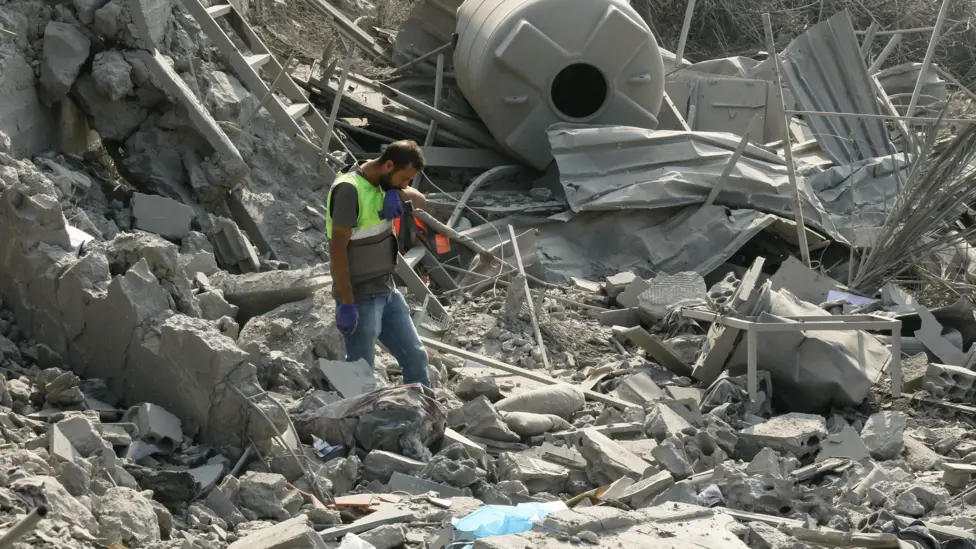
At least 11 people have been killed in Israeli airstrikes across southern Lebanon, according to Lebanese authorities, in the deadliest escalation since a truce between Israel and Hezbollah took effect in June.
Seven people were killed when an Israeli strike hit a house on the outskirts of Ansar, about 70km (43 miles) south of Beirut, Lebanese authorities said. State media reported that three children and two women were among those killed. The attack also left several people wounded.
The Lebanese Health Ministry later reported that four more people were killed and five injured in an Israeli strike on Deir al-Zahrani.
The attacks came amid renewed tensions between Israel and Hezbollah despite a US-mediated framework agreement announced in June that is intended to reduce hostilities, facilitate the gradual withdrawal of Israeli forces from southern Lebanon and lead to the disarmament of Hezbollah.
Israel's military said its forces had targeted Hezbollah infrastructure after an attack on Israeli troops in the area. The IDF said the operation killed Ali Samir al-Haj Hassan, whom it identified as a Hezbollah battalion commander in the group's Radwan Force.
According to the Israeli military, the target was located in the Ali al-Taher area, a strategic ridge overlooking parts of southeastern Lebanon. Israel said the Hezbollah position had been used to plan attacks against its soldiers.
The IDF also said civilians were present at the site and claimed Hezbollah had used them as human shields. Lebanese authorities, however, said the Ansar strike hit a location where displaced families were staying and condemned the deaths as civilian casualties.
Lebanese Prime Minister Nawaf Salam denounced the strikes and called for an immediate end to the escalation. He said the victims in Ansar were civilians rather than members of a military facility and warned that continued Israeli attacks threatened Lebanon's security and stability.
President Joseph Aoun also condemned the strikes, particularly the deaths of members of the same family in Ansar. He described the attacks as further violations of the June framework and said they sent a serious message to international efforts aimed at stabilising the situation.
Hezbollah rejected Israel's account of the Ansar strike and accused Israel of deliberately targeting civilians. The group said claims that the locations were military sites were being used to justify attacks on residential areas.
The latest violence follows months of conflict in Lebanon that intensified after Hezbollah launched attacks against Israel in response to the wider regional war involving Israel, the United States and Iran. Israel subsequently expanded its military campaign across Lebanon and established a security zone in the south.
The June framework calls for Hezbollah to disarm, Israeli forces to withdraw gradually from southern Lebanon and the Lebanese army to assume control of the area. Hezbollah was not a party to the agreement and has rejected direct negotiations with Israel.
Israel says its forces will continue operations against what it describes as threats to Israeli soldiers and civilians in the security zone, while Lebanese officials have repeatedly called for an end to Israeli strikes and the withdrawal of Israeli forces.
Despite the reduction in fighting following the June agreement, Israeli airstrikes and demolitions have continued in parts of southern Lebanon. The latest attacks have raised renewed concerns that the fragile truce could deteriorate further.
Lebanese and Israeli representatives are expected to hold another round of negotiations in September as efforts continue to establish longer-term arrangements for the border and southern Lebanon. A final date for the talks has yet to be announced.
Sources: Lebanese Ministry of Public Health and National News Agency; Israel Defense Forces; statements from Lebanese Prime Minister Nawaf Salam and President Joseph Aoun; Reuters; Associated Press.