


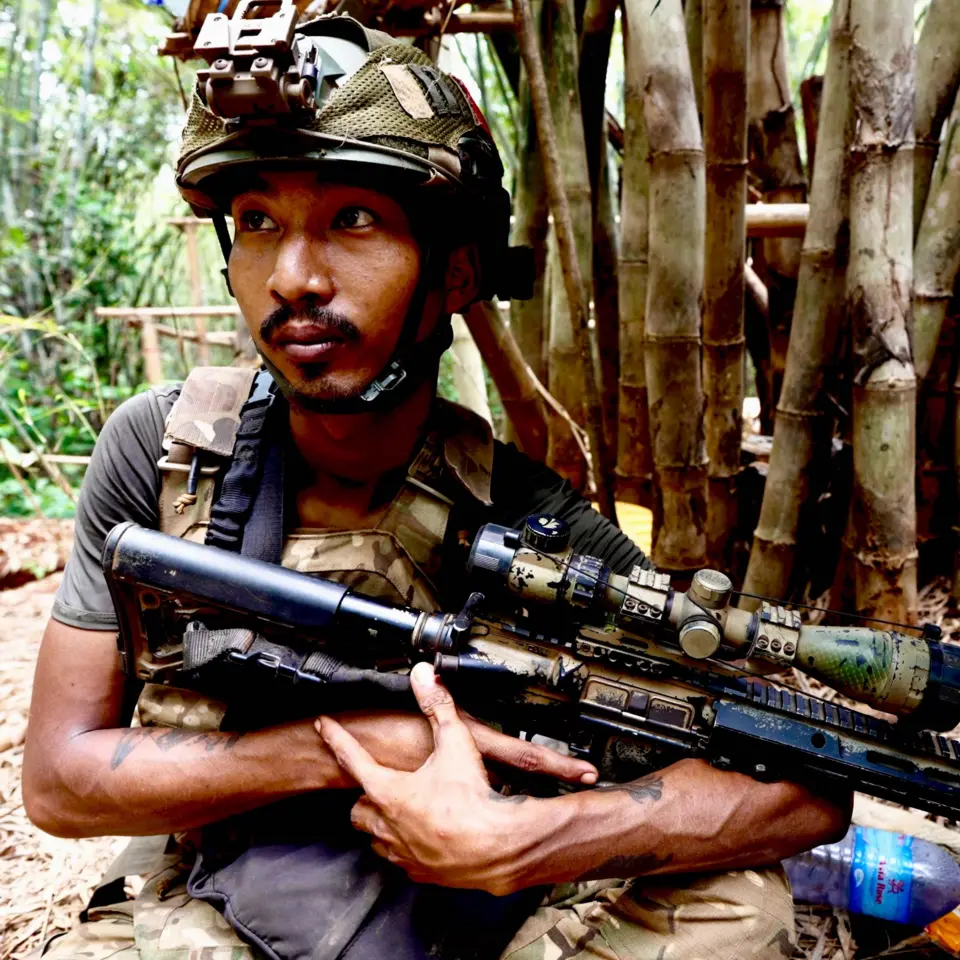
Deep within the jungle-covered mountains of Myanmar, a rebel camp houses four young men who never intended to fight. Their path to the frontline was not a choice, but the result of the military junta's aggressive forced conscription policy. One was a chef detained on his way home from work for lacking identification, another was seized after a late-night karaoke session, a third was taken from his job at the forestry department, and the fourth was framed with planted drugs to compel his enlistment.
Aged between 19 and 25, these men were deployed to the front lines in Karen State with minimal preparation, subjected to relentless labor while regular soldiers faced fewer demands. After four months of basic training, they seized an opportunity to desert during a routine trip to wash, eventually encountering a patrol of the opposition People's Defence Force (PDF). Now detained in the rebel camp, they report experiencing better treatment, though they plan to eventually move to the Thai border to escape potential military retribution against themselves and their families.
The Shift on the Battlefield
The influx of forced recruits has significantly altered the trajectory of the conflict, which began when the military seized power in a 2021 coup, ousting and jailing democratically elected leader Aung San Suu Kyi. While an alliance of ethnic and rebel groups achieved major territorial gains over two years ago, the resistance has largely been forced onto the defensive.
The military currently controls less than half of the country but continues to advance. Junta forces have reclaimed key townships and a strategic highway connecting Mandalay to Myitkyina, while thousands of troops are moving to re-establish control over border regions in Kachin, Chin, and Karen states.
Resistance commanders acknowledge that forced conscription has provided the junta with vast manpower reserves. PDF battalion commander Ko Kaung notes that despite the resistance possessing technological and intellectual advantages, limited funding severely restricts their ability to source vital components or match the military’s recruitment capacity. Ko Kaung’s forces captured the town of Hpapun and its military base two years ago, but the area remains heavily damaged by regular bombardments, and they now face an advancing force of roughly 2,000 junta soldiers alongside persistent drone surveillance.
Evolving Tactics and Resource Scarcity
In the mountain camps, PDF commander Da Wa, a former political activist who served over four years in prison, observes that the conscripts are becoming more effective as they grow accustomed to following orders. Holding territory has become increasingly difficult; a base captured by the rebels was lost within days due to intense artillery and airstrikes.
The challenges facing the resistance are compounded by shifting military tactics and international dynamics:
-
Increased Air Power: Following a security pact with Russia, the junta has deployed more aircraft, frequently utilizing pairs of fixed-wing planes instead of single units.
-
Drone Superiority: The military maintains an advantage in both drone technology and quantity, creating an urgent need for signal jammers among rebel forces.
-
Geopolitical Factors: Ceasefires brokered by China—which holds significant mining and financial investments in Karen and Kachin states—have slowed the momentum of certain rebel factions, while restrictions on the flow of weapons have choked resistance supply lines.
This lack of ammunition forces rebel fighters to ration bullets strictly during engagements. Furthermore, physical dangers extend beyond direct combat. Myanmar is currently one of the most heavily mined nations globally. According to recent data, landmines caused 745 casualties over the past year, with children accounting for approximately 25% of the victims.
Healthcare on the Frontline
Injured fighters are treated in hidden jungle clinics operating on minimal resources. Dr. Saung, a military academy veteran who served nearly two decades in the state armed forces, manages a field hospital constructed from bamboo and wood. The facility relies entirely on solar power and a backup generator, operates without an ambulance, and faces constant shortages of funds and medical supplies.
Despite these constraints, the medical staff continues to support both wounded combatants and displaced civilians. In one sector of the hospital, the wife of a resistance fighter recently gave birth to a daughter. The parents express a desire for their child to grow up in a democratic nation and hope to eventually introduce her to their extended families, a trip currently prevented by ongoing hostilities and divisions within their home villages.