


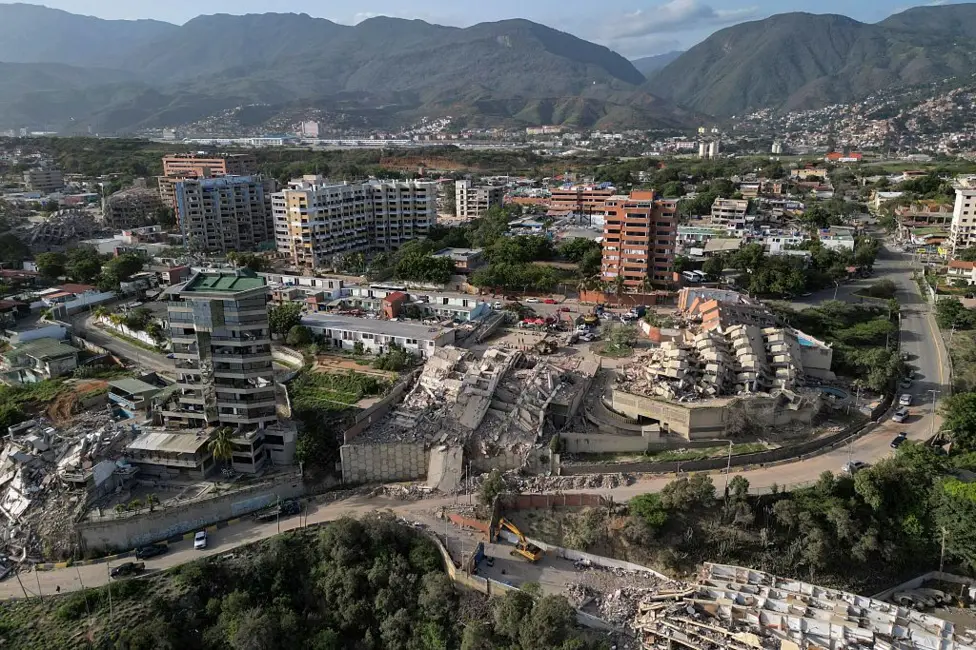
VENEZUELA: Rescue workers and local residents are engaging in a desperate, time-sensitive search for survivors following two major earthquakes that struck Venezuela on Wednesday. The consecutive seismic events, measuring 7.2 and 7.5 magnitude, have caused widespread catastrophic destruction across the coastal state of La Guaira and areas surrounding the capital district of Caracas. The 7.5 magnitude tremor stands as one of the most powerful earthquakes recorded in the nation’s history over the past century.
Escalating Casualties and Missing Persons
Official reports have confirmed at least 1,430 fatalities, though the death toll and injury count continue to rise steadily. The United Nations estimates that approximately 50,000 individuals remain missing, with thousands believed to be trapped beneath the rubble of hundreds of collapsed structures.
In hard-hit coastal towns such as Catia La Mar, Macuto, and Caribe, structural damage is near-total, leaving few buildings standing. Complicating the recovery efforts, the decomposition of victims beneath the debris has raised immediate public health concerns regarding potential disease outbreaks among survivors and children.
International Relief Mobilization
Faced with a severe shortage of domestic rescue personnel, Venezuela has received an influx of international aid. As of Friday, authorities confirmed the arrival of 861 foreign volunteers and specialist teams from nations including Mexico, Spain, the United States, the United Kingdom, El Salvador, Switzerland, and Colombia.
The rescue operations rely heavily on acoustic detection and civilian technology. Teams frequently mandate periods of absolute silence across disaster zones to listen for survivors trapped under concrete and wire grid debris. Additionally, localized search efforts are utilizing consumer drones to scout unstable or inaccessible areas, with families monitoring video feeds for signs of missing relatives.
Government Response and Logistical Challenges
The Venezuelan government has begun distributing essential provisions, including food and water, to affected populations. Interim President Delcy Rodríguez announced the deployment of a comprehensive emergency response, emphasizing that operations remain in a critical window. Humanitarian agencies note that the initial 48 to 72 hours are vital for life-saving rescues, though survival timelines can extend if trapped individuals have access to pockets of water and air.
In diplomatic developments, Interim President Rodríguez held communications with U.S. President Donald Trump and U.S. Secretary of State Marco Rubio, who affirmed commitments to dispatch further rescue teams and humanitarian supplies.
Displacement and Humanitarian Impact
The disaster has left thousands of residents displaced and lacking basic necessities. Massive crowds and heavy traffic have occasionally congested transit routes, hindering the movement of heavy machinery and rescue operations.
Due to structural damage, the Simón Bolívar International Airport in Maiquetía has suspended flight operations. However, its expansive, flat parking facilities are currently serving as a makeshift open-air shelter for displaced families seeking refuge from unstable buildings and potential aftershocks. Many residents face severe logistical obstacles, attempting to salvage essential documents and minimal belongings from compromised high-rise structures while navigating a complete lack of specialized heavy lifting equipment.