


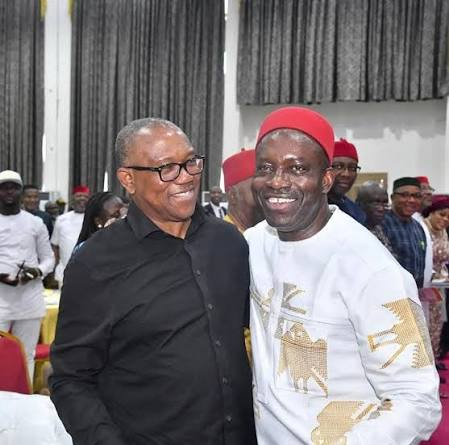
Governor Charles Soludo had earlier indicated that he would release a second instalment of his essay on former Anambra State Governor Peter Obi. The latest intervention, issued through his Commissioner for Information, Dr Law Mefor, has now triggered a detailed rebuttal from those defending Obi’s record in office.
The response argues that what was presented as a factual account of Anambra’s financial history amounts instead to an attempt to reinterpret the state’s past through contemporary economic conditions and political narratives.
At the heart of the dispute are questions over debt, development financing, public expenditure, savings, infrastructure and the legacy inherited by successive administrations.
The central argument advanced by Obi’s defenders is that the figures cited by the Soludo administration require context, particularly where multilateral development financing, concessionary credits and state-level debt obligations are concerned.
They also challenge the use of current exchange rates to assess historical expenditure and argue that such an approach can produce dramatically inflated naira equivalents that do not accurately represent the fiscal circumstances under which those expenditures were made.
The $4.05 billion question
One of the figures under contention is the claim that about $4.05 billion, equivalent to approximately N5.4 trillion at the current exchange rate, was spent during the period under review.
Obi’s supporters argue that the figure becomes misleading when removed from the size of government budgets, the value of the naira at the time, the distinction between expenditure and liabilities, and the different sources of financing involved.
They contend that a meaningful assessment should begin with the cumulative budgets available to the administration during its eight years in office rather than converting historical figures into today's naira and presenting the resulting number as though the spending occurred under today's economic conditions.
They also point to the dramatic increase in revenues available to state governments in recent years as an important factor in comparing administrations across different periods.
President Bola Tinubu has previously spoken about the substantially higher allocations available to state governments compared with earlier administrations. Obi's defenders argue that such differences should be taken into account when comparing the volume of projects undertaken by governors who operated under markedly different fiscal circumstances.
They maintain, however, that Soludo's administration should ultimately be judged on its complete record after the end of its tenure rather than through an interim comparison.
The dispute over water, education and healthcare
A major component of the Soludo administration's argument concerns the condition of Anambra's public infrastructure when Obi left office.
The response rejects the assertion that Obi left behind a state without functioning water schemes, adequate public schools or meaningful healthcare infrastructure.
On water, Obi's defenders point to efforts to rehabilitate dormant water schemes during his administration. They cite, among other examples, the commissioning of a water project in Nnewi involving European Union representatives as evidence that the administration was not indifferent to the state's water infrastructure.
The broader argument is that judging an administration's record solely by the condition of facilities years after it left office ignores the investments and reforms undertaken during its tenure.
Education as a central part of Obi's record
Education remains one of the strongest areas highlighted by Obi's supporters.
They argue that his administration implemented interventions across primary, secondary and tertiary education, including the return of mission schools to their original proprietors, financial support for school rehabilitation, classroom construction and the provision of basic infrastructure.
According to the account being advanced by Obi's defenders, more than N2 billion was provided in grants associated with the return of mission schools, while five-classroom blocks were constructed across the state's communities.
The administration is also credited with renovating numerous dilapidated schools, installing boreholes in hundreds of schools and introducing technology-focused initiatives.
These included the distribution of thousands of computers, the establishment of Microsoft Academies in secondary schools, internet connectivity, generators, libraries and other educational facilities.
Obi's supporters also point to teacher recruitment, salary interventions, promotions and efforts to address pension and gratuity obligations involving education workers.
At the tertiary level, they cite substantial investment in Chukwuemeka Odumegwu Ojukwu University, Nwafor Orizu College of Education, the College of Agriculture, Mgbakwu, and the development of a teaching hospital.
They further argue that Obi's administration provided financial assistance to private tertiary institutions attended by Anambra indigenes and introduced rewards for academic excellence, including financial recognition for first-class graduates.
The argument from Obi's camp is therefore straightforward: rather than debating the legacy through political statements, the two administrations should place their education records side by side and compare projects, funding, institutions and measurable outcomes.
Healthcare: infrastructure and institutional partnerships
Healthcare is another area where the competing narratives diverge sharply.
Obi's supporters maintain that his administration pursued a combination of direct government investment and partnerships with mission-owned healthcare institutions.
They point to the development of the Chukwuemeka Odumegwu Ojukwu University Teaching Hospital in Awka, the Joseph Nwilo Heart Centre at St Joseph's Hospital, Adazi-Nnukwu, and the installation of a public dialysis facility at General Hospital, Onitsha.
They also highlight financial interventions involving several mission hospitals, arguing that these facilities served a substantial proportion of the state's population despite not being directly owned by the government.
Among the institutions mentioned are Iyienu Hospital, Ogidi; Our Lady of Lourdes Hospital, Ihiala; St Charles Borromeo Hospital, Onitsha; Amichi Diocesan Hospital; Holy Rosary Hospital, Waterside; and St Joseph's Hospital, Adazi-Nnukwu.
The argument is that government support for such institutions should be regarded as part of the state's healthcare investment even where ownership remained with religious organisations.
Obi's supporters also cite Anambra's partnership with the Bill & Melinda Gates Foundation and a reported $1 million grant associated with polio eradication and immunisation efforts in 2013. They say the funds were matched to support the construction of maternal and child health centres.
They further argue that several health institutions gained accreditation during Obi's tenure and challenge the present administration to provide a comparable record of newly accredited facilities and major healthcare investments.
Urban development and the UN-Habitat connection
The rebuttal also challenges the suggestion that Obi's infrastructure record was primarily about roads.
It points to collaboration with UN-Habitat on structure plans for Awka, Onitsha and Nnewi as part of a broader urban-development strategy.
According to Obi's defenders, those plans informed initiatives such as the development of shopping malls in the three major cities.
They also recall the extensive rehabilitation of Onitsha, road improvements, industrial development and efforts to attract businesses back to the commercial city.
A particularly significant claim concerns the recognition of Onitsha by UN-Habitat in 2010 as one of five fast-growing cities whose photographs were displayed during a World Exhibition in Shanghai, China, to mark UN-Habitat Day.
Obi's supporters argue that such recognition should form part of any assessment of the administration's urban-development record.
Security and the restoration of public order
Security is another area where Obi's supporters point to substantial state intervention.
They argue that the administration invested heavily in logistics and security equipment, including armoured personnel carriers and patrol vehicles, while working with security agencies and community stakeholders.
Former police officials and security figures have, at various times, acknowledged the importance of state support for police operations during that period.
Obi's defenders particularly point to efforts against criminal networks operating around areas such as Akpaka Forest and argue that the administration's policy of providing logistical support to security agencies contributed to the restoration of public order.
They also maintain that several security policies introduced during the period, including measures targeting properties linked to kidnappers, have remained part of subsequent administrations' security strategies.
The DMO records and the debt argument
The most contentious part of the dispute concerns Anambra's external debt.
The Soludo administration has relied on Debt Management Office records in discussing external obligations associated with the state. The figure cited in the current debate includes an external debt stock of about $92.35 million, which the administration presents in its broader assessment of the state's inherited financial obligations.
Obi's supporters argue that the presentation requires a more careful distinction between commercial borrowing, multilateral development financing, sovereign credits and concessionary development programmes.
They contend that several of the programmes listed as borrowing associated with Obi were not conventional commercial loans raised by the state government for recurrent expenditure or political patronage.
Instead, they say, many were multilateral development programmes involving institutions such as the World Bank's International Development Association and the International Fund for Agricultural Development.
The distinction is important because concessionary development financing typically operates under significantly different terms from commercial borrowing, including lower interest rates, extended repayment periods and moratoriums.
The response therefore argues that simply grouping such facilities under the political label of loans taken by a governor risks obscuring how the programmes were actually structured.
The eight development programmes
The Soludo administration's account identifies a number of external development programmes associated with the period, including the Malaria Control Booster Project, Fadama III, Health System Development Project II, State Education Programme Investment Project, Community and Social Development Project, NEWMAP and the Value Chain Development Project.
Obi's defenders argue that the history of each programme must be examined separately.
They particularly dispute the suggestion that all the programmes were fully drawn down and utilised by Obi's administration.
According to the rebuttal, three programmes — SEPIP, CSDP and NEWMAP — were not substantially drawn down during Obi's tenure and had significant implementation or disbursement activity under subsequent administrations.
That distinction, they argue, makes it necessary to identify the dates of approval, signing, drawdown, expenditure and implementation before attributing the resulting liabilities or benefits to a particular governor.
They have challenged the Soludo administration to publish the detailed financial records showing when each facility was accessed, the amounts drawn, the projects financed and the administrations under which the funds were utilised.
NEWMAP and the erosion crisis
The Nigeria Erosion and Watershed Management Project has become a particularly important point of disagreement.
Obi's supporters say the programme emerged from his administration's efforts to draw national and international attention to Anambra's severe erosion crisis.
They argue that Obi pushed for federal and international intervention and helped establish the conditions that enabled the state to participate in the World Bank-supported programme.
The financing structure, they contend, was an IDA-backed sovereign development credit rather than a conventional commercial loan independently negotiated by the Anambra State Government.
They also argue that Obi's administration paid the required counterpart contribution but did not itself spend the main facility funds before leaving office.
Subsequent administrations, including those of Willie Obiano and Soludo, were responsible for substantial implementation of erosion-control projects under the programme.
This is why Obi's defenders regard it as contradictory for a government to benefit from the programme's infrastructure and continue paying counterpart contributions while simultaneously presenting the underlying development financing primarily as evidence of reckless borrowing by a former governor.
The issue, they argue, is not whether the programme constituted development financing, but how responsibility for its financing, drawdown and implementation should properly be attributed.
The Community and Social Development Project
A similar argument is made regarding the Community and Social Development Project.
Obi's defenders acknowledge that the programme was introduced during his tenure but maintain that implementation in Anambra did not proceed as initially envisaged because of disagreements between the state government and the World Bank.
They argue that subsequent implementation took place under the Obiano administration and that any assessment of the programme should distinguish between its introduction, financing, drawdown and actual implementation.
Pension and gratuity allegations
Another disputed issue concerns outstanding salaries, pensions and gratuities allegedly inherited from the Obi administration.
Obi's supporters strongly reject the suggestion that he left substantial unpaid pension and gratuity obligations.
They maintain that his administration cleared pension and gratuity arrears estimated at about N35 billion and that retirees subsequently received gratuity payments.
They also argue that any discussion of unpaid obligations should specify the years covered, the beneficiaries affected and the administration responsible for the arrears.
Their position is that broad references to inherited liabilities without dates and itemised records make it difficult to establish which administration actually incurred or cleared a particular obligation.
The Water Corporation dispute
The controversy over the Anambra State Water Corporation presents a different issue.
Obi's defenders acknowledge that employees of the Water Corporation had salary-related grievances but argue that the administration's position was based on the agency's productivity and ability to justify continued expenditure.
According to their account, Obi sought a viable plan for restoring effective water supply before committing additional public funds to the corporation.
They characterise the decision as an attempt to link government spending to measurable public service delivery rather than an arbitrary refusal to pay workers.
That interpretation remains part of the wider political disagreement over the management of state-owned agencies and public expenditure.
The disputed N75 billion savings
Perhaps the most politically significant issue is the question of the savings and investments Obi allegedly left behind.
The Soludo administration has questioned the accounting surrounding the reported N75 billion in savings and investments attributed to the previous administration.
Obi's supporters argue that the funds were real and that their existence can be established through banking and investment records.
They point particularly to testimony published by former Diamond Bank Group Managing Director Alex Otti in 2020.
According to Otti's account, the bank helped facilitate the conversion of approximately $155 million of Anambra's funds into foreign-denominated investments in 2014.
The funds were reportedly distributed across Diamond Bank, Access Bank and Fidelity Bank and invested in Tier-2 capital instruments.
Obi's defenders say Otti's account provides independent evidence that substantial financial assets existed at the end of the administration and that the value of those assets increased significantly as a result of interest earnings and subsequent exchange-rate movements.
The argument is therefore that the savings should not be dismissed simply because their present naira value has changed dramatically.
Contracts are not automatically debt
Another point raised in the rebuttal concerns the treatment of contracts awarded during Obi's administration.
Obi's supporters argue that the value of contracts awarded by a government cannot automatically be classified as debt.
Where a contract was completed and paid for before the administration left office, they contend, it should not subsequently be presented as an outstanding liability.
Conversely, where a contract was awarded but remained incomplete or unpaid, the outstanding obligation should be identified specifically and attributed according to the contractual and financial records.
The same principle, they argue, should apply to every administration rather than being used selectively against one government.
The larger question: debt, development or political accounting?
At its core, the dispute between the Obi and Soludo camps is not simply about individual figures.
It is about how governments should measure the financial legacy of previous administrations.
One side emphasises inherited liabilities, external debt records and outstanding obligations. The other emphasises savings, development programmes, infrastructure, institutional reforms and the distinction between concessionary development financing and conventional commercial borrowing.
Both sides are effectively using different accounting and political lenses to describe the same based on converting old expenditures into today's naira, collapsing different categories of development financing into a single the debate away from competing political narratives and towards an evidence-based reconstruction of Anambra's fiscal history therefore be less about who can produce the stronger political argument and more about who can produce the underlying documents that historical period.
For that reason, the most useful way to resolve the disagreement would be to publish the underlying records.
Every disputed debt should have a date, source, amount, purpose, repayment terms and drawdown history.
Every alleged unpaid obligation should identify the beneficiary, contractual basis, date incurred and administration responsible.
Every claimed saving should be supported by bank statements, investment records and audited accounts.
And every development programme should be traced from approval and financing through drawdown, implementation and expenditure.
Let the records settle the argument
The central argument advanced by Obi's defenders is not that his administration was flawless. No government is.
Rather, they contend that historical assessment should not be based on converting old expenditures into today's naira, collapsing different categories of development financing into a single debt figure, or ignoring investments and savings because they complicate a particular political narrative.
The debate over Obi's legacy will inevitably remain political. But the financial questions are capable of being answered through documents.
If Anambra inherited debts, the specific debts should be identified.
If liabilities remained unpaid, the amounts, dates and beneficiaries should be published.
If development facilities were drawn down after Obi left office, the drawdown records should establish when and by whom.
If savings and investments existed at the end of his tenure, the relevant financial records should demonstrate their value and subsequent movement.
And if major projects were completed, their costs, dates and sources of funding should be placed in the public domain.
That would move the debate away from competing political narratives and towards an evidence-based reconstruction of Anambra's fiscal history.
History is ultimately tested against records. In the continuing Obi-Soludo dispute, the most consequential question may therefore be less about who can produce the stronger political argument and more about who can produce the underlying documents that allow the public to independently verify the claims.